Esports Manager 2026 Best Tactics Guide
Esports Manager 2026 does not have one magic tactic that carries every roster, but the best early setups usually share the same idea: keep the call simple enough for your team to execute, give your strongest players the fights they are built to win, and stop judging tactics without checking map prep, role fit, and economy first. A basic site hit with trade support, a slower default built around your AWPer, or a clean anti-eco setup will do more for a new save than some overdesigned custom tactic your players have barely practiced.
Best Tactics To Use Early In Esports Manager 2026
The best early tactics are not the flashiest ones in the menu. They are the calls that match what your roster can already do. If your team is new, your IGL is still developing, and your map percentages are uneven, the last thing you need is a complicated setup that asks every player to hit perfect timings. Start with stable calls that create trades, protect the bomb, and avoid sending one player into five different problems at once.
| Situation | Best Tactical Approach | Why It Works |
|---|---|---|
| New roster | Simple site hits with trade support | New teams need structure more than clever routes. |
| Strong riflers | Grouped pressure and trading routes | Lets your best gunfighters create value without isolating them. |
| Strong AWPer | Slower defaults and angle control | Gives the sniper time to find picks before the full hit starts. |
| Opponent keeps stacking | Slow the round or pressure the other site | Stops you from running into the same read over and over. |
| Opponent is on eco | Clean grouped execute | Reduces the chance of donating rifles in a round you should win. |
Early on, I would rather win ugly with a tactic the team understands than lose beautifully with a custom route that only makes sense in your head. The tactic screen can make every idea look organized, but the match will tell you very quickly whether your players are actually ready to run it.
Build Tactics Around Your Roster, Not The Other Way Around
Your roster should decide which tactics make sense. If your riflers are the strength of the team, you want calls that let them trade into sites together instead of spreading them into isolated fights. If your AWPer is your best player, slower defaults and angle-control setups give that player more room to create the opening before the rest of the team commits. If your IGL or Tactic attribute is weak, simpler calls are not boring. They are survival.
This is where a lot of players make the game harder than it needs to be. They find a tactic that looks strong, force the roster into it, and then start blaming the players when the call falls apart. Sometimes that is fair. Sometimes the tactic is asking for a level of role execution the team does not have yet. A good plan for one roster can be a very expensive disaster for another.
I would not build around theory before checking what the players can actually handle. If the entry player cannot win opening fights, do not design the whole attack around him hero-clearing space. If the AWPer is undertrained, do not create a setup where the round depends on one sniper pick. If your support players have weak Grenades or Tactic numbers, do not act shocked when utility-heavy hits feel like five people politely throwing objects near the bombsite.
Best Attacking Tactics For New Saves
On attack, the strongest early tactic is usually a straightforward site hit with enough players grouped to trade properly. It is not exciting, but it gives a new roster fewer ways to embarrass itself. The team moves together, the entry has support, and if the first duel goes badly, the round does not instantly become one player lurking on the wrong side of the map while everyone else dies in a doorway.
Once the roster is more stable, slower defaults become more useful. A default lets your AWPer look for picks, gives riflers time to pressure space, and helps you read whether the opponent is overloading a site. The danger is running defaults with a team that has no discipline yet. If your players are losing every solo fight or wandering into bad timings, a default can turn into five separate ways to lose the same round.
Split attacks are better once you know the map and roles well enough to trust the timing. A split can punish a stacked defense, but it also asks the team to arrive together from different lanes. If one side is late, the other side usually gets farmed. Use splits when your map practice and role fit are strong enough to support them, not because “Split B” sounds like the game is offering you free strategy.
Best Defensive Tactics For Holding Sites
On defense, the best early setup is usually a balanced hold that keeps your players in roles they can actually play. Do not over-rotate before the opponent has shown you a pattern, and do not stack a site just because one round went badly. A balanced setup gives you information, keeps the map playable, and buys time to see what the other team is trying to repeat.
Once the opponent starts showing habits, you can get more aggressive. If they keep hitting the same route, lean into the site earlier or adjust the utility around that lane. If they are defaulting slowly and your players can win the duels, controlled aggression can take away space before the hit forms. If your players are not winning those fights, stop feeding them isolated duels and make the opponent walk into crossfires instead.
The defensive mistake I hate most is panic-stacking. One bad round on A does not mean A is doomed forever. Two or three rounds with the same pressure, timing, and player deaths is a pattern. React to the pattern, not the emotional damage.
Best Anti-Eco Tactics
Against eco rounds, the best tactic is usually the least dramatic one. Keep players together, trade every fight, and avoid giving the opponent a rifle because someone wanted to clear a corner like he was auditioning for a highlight reel. Eco rounds are not where you prove how brave your players are. They are where you remove the opponent’s cheap comeback chance.
On attack, that usually means grouped pressure and simple spacing. Do not split the team into isolated duels against pistols or weak weapons. On defense, avoid over-peeking alone just because the buy looks harmless. A bad eco loss can wreck the economy, flip momentum, and make your next few rounds uglier than they needed to be.
If your team keeps losing anti-eco rounds, I would look at spacing and discipline before blaming the tactic itself. A reasonable call can still collapse if players donate fights one by one. The goal is not style. The goal is a round that ends quietly with all the expensive weapons still on your side.
Best Force Buy Tactics
Force buy rounds are where your calls need to respect risk instead of pretending the team has a full kit. If you are forcing, the tactic should either create an early advantage or stack players into a fight you can actually win. Half-committing to a normal full-buy plan with worse equipment is how you get the worst of both worlds.
On attack, force buys usually work better when you simplify the win condition. Group faster, trade tightly, and try to overwhelm one part of the map before the equipment gap drags the round out. On defense, a force buy can justify a heavier stack or a more aggressive information play, but only if you are prepared for the round to get weird. That is the whole appeal and the whole danger.
I would not judge your main tactics from a force buy unless the tactic was specifically designed for that economy state. A call that fails with weak weapons may still be fine when the team is fully bought. A call that only works because the opponent walked into a force-buy trap may not be reliable when they slow down and clear properly.
When To Switch Tactics Mid-Match
Switch tactics when the opponent has started answering the call, not because one round annoyed you. A single lost round can come from a missed duel, bad timing, economy, or one player doing something that makes you question whether the mouse was plugged in. Repeated punishment is different. That is when the match is telling you the call has been read.
If you hit the same site twice and the defense suddenly stacks it, move the pressure somewhere else or slow the round down. If your entry keeps dying in the same lane, change the support around him or stop sending him there. If the bomb keeps getting stuck behind the same fight, the route is not creating clean pressure and needs adjustment.
Random switching is just as bad as stubbornness. If you change the plan after every lost round, you never learn what failed. Give a tactic enough time to show whether it is being answered, then switch because the match has given you evidence. The best mid-match calling is not frantic. It is annoying, patient, and hard for the opponent to settle against.
When To Use Tactic Creator
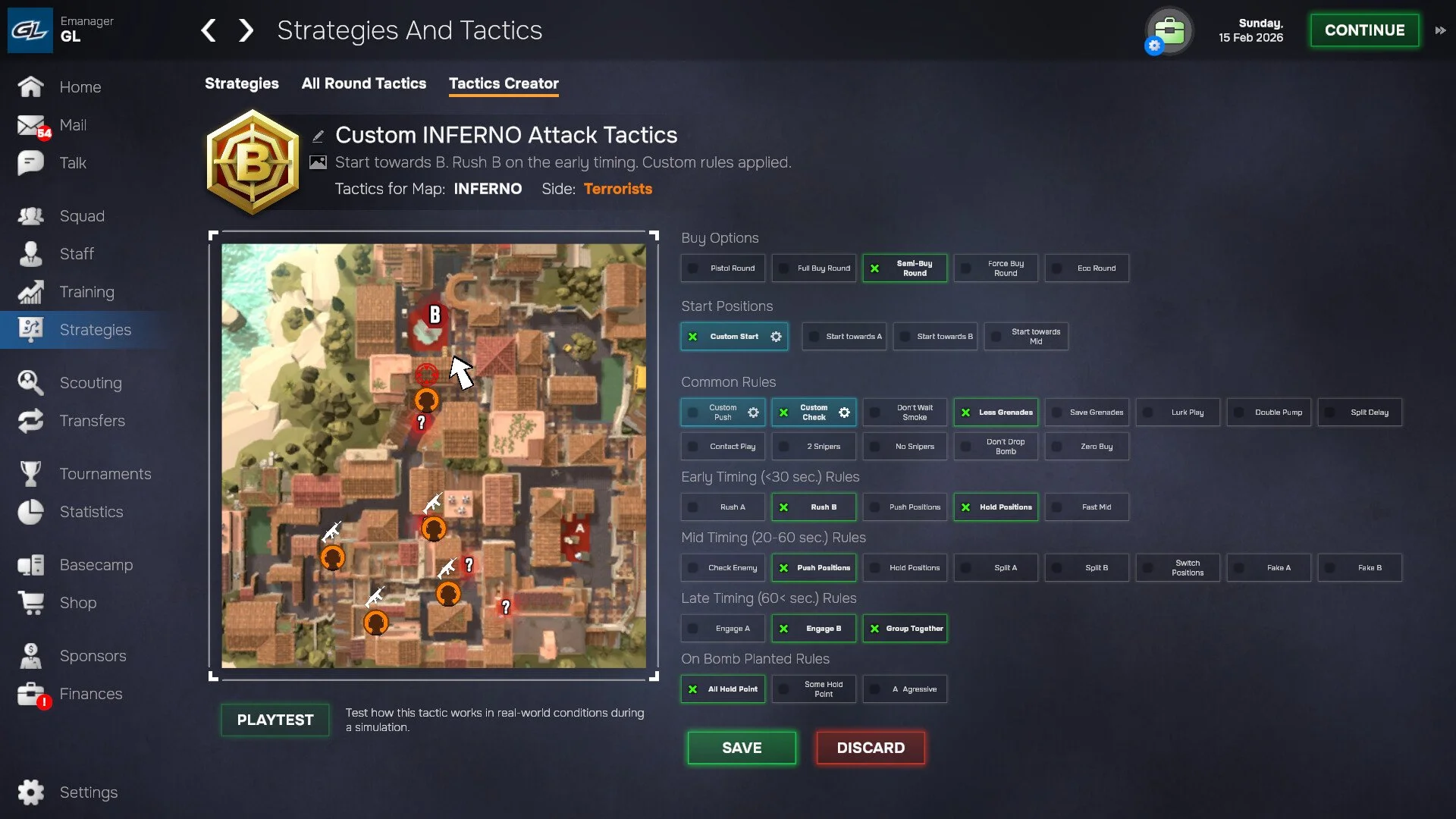
Use Tactic Creator after you already know what behavior needs to change. Do not open it just because the team lost and you want the screen to feel more managerial. Custom tactics are useful when a predefined call is close, but the route, spacing, or zone behavior keeps breaking in the same place.
That might mean your split is arriving late on one side, your entry is being sent into the wrong duel, your AWPer is not getting the angle he needs, or the bomb keeps stalling behind the pressure instead of moving with it. Those are good reasons to customize a tactic because you are solving a known map problem.
If the issue is basic, fix the basic issue first. A custom tactic will not save an undertrained map, a bad role fit, or an economy call that asks pistols to behave like rifles. Tactic Creator is strongest when it sharpens a plan that already makes sense. It is weakest when it becomes a hiding place for bad diagnosis.
How To Train For Better Tactics
The best tactics are easier to run when training is tied to the call you actually want to use. If your plan needs clean entries, train the player who is taking those first fights. If your plan leans on utility, look at Grenades, Tactic, and Creativity instead of pretending every problem is a rifle problem. If your late rounds keep falling apart, Clutch and Tactic may matter more than another week of padding a weapon stat that is already strong.
The three-attribute limit is useful because it forces you to pick a lane. Train the three stats that explain the next match problem, not the three stats that make the profile look prettier. A low number only matters if the player’s role needs that number. Training a random weak stat is not strategy. It is housekeeping.
| Tactic You Want To Run | Training To Prioritize | Why It Matters |
|---|---|---|
| Trade-heavy site hits | Rifle, Tactic, Clutch | Helps players win fights and convert pressure. |
| AWP defaults | AWP, Tactic, Creativity | Supports pick setups and smarter map control. |
| Utility executes | Grenades, Tactic, Creativity | Makes the setup behind the hit less sloppy. |
| Late-round calls | Clutch, Tactic, role weapon stat | Targets pressure rounds instead of only easy conversions. |
Auto Schedule is fine while you are still learning the roster, but once the same problem appears twice, manual training should start taking over. At that point, the game has already told you what hurts. Ignoring it and leaving training generic is just procrastination with a calendar.
Practice The Map Your Tactics Depend On
A tactic only works if the team understands the map well enough to run it. If your best call is built around a map where your percentage is low, expect the match to expose that immediately. Players arrive late, fights happen in the wrong order, utility feels off, and suddenly the tactic looks bad even if the idea was fine.
Do not only practice your best map because it feels good. The next tournament pool should decide the priority. If your best map is likely to be available, keep it sharp. If a weak map can be forced as a decider, train it before the bracket does the ugly testing for you.
I would rather make a bad map survivable than make a good map slightly prettier before an event that can punish the bad one. Comfort is nice, but tournament risk is the better coach.
Use Scrims To Test One Tactic Question
Scrims should answer one question at a time. If you enter a scrim just to see what happens, you usually leave with a scoreline and a story you made up afterward. That is not useless, but it is close enough to annoy me.
Before the scrim starts, decide what you are testing. Does the slower default give your AWPer better openings? Does the new site hit trade properly? Can the team punish an eco round without donating weapons? Did Map Practice actually make the weak map playable? Keep the test narrow so the result tells you something.
A scrim win does not automatically mean the tactic is ready, and a scrim loss does not automatically mean the idea is dead. The only question that matters is whether the scrim gave you a useful answer. If it did, adjust from there. If it did not, the problem was probably the way you set up the test.
Use Timeouts And Halftime Talks Before The Match Runs Away
Timeouts and halftime talks are best used when the team state is becoming part of the problem. If the tactic is fine but composure is slipping, a new call alone may not fix anything. You need a reset before the match turns into five players quietly losing confidence in real time.
I would not call a timeout after one weird round unless the economy or scoreline makes it urgent. One round can be noise. Several rounds with the same mistakes, same rushed fights, and same bad reactions is a trend. That is when a pause makes sense. Use it to steady the team, make one tactical adjustment, and then give the next few rounds enough time to show whether the reset worked.
Halftime talks work the same way. Do not use them as empty motivation if the side priority needs to change. Do not rewrite the entire plan if the team mostly needs composure. Decide whether you are fixing morale, route choice, or execution, then keep the adjustment narrow enough to read.
Best Tactics Routine For A New Save
For a new save, start with simple trade-heavy tactics, use slower defaults if your AWPer is one of your better players, and keep anti-eco rounds boring enough that your team stops donating weapons. Let Auto Schedule handle the first stretch while you learn the roster, then switch to manual training once a specific weakness appears. Practice the map the tournament can punish, scrim one question at a time, and only use Tactic Creator when you already know what behavior needs to change.
If the roster, staff, money, or sponsor setup is still messy, fix that foundation before trying to micromanage every round. The Esports Manager 2026 best start guide is the better next read if your org is still unstable, because tactics become a lot easier to judge once the team around them is not quietly falling apart.
My approach would be to keep the first tactical setup boring until the roster proves it can handle more. Run the call your players can execute, not the one that makes you feel clever. Once the team starts showing patterns, build from there: train the role, practice the map, test the tactic, respect the money, and switch only when the match gives you a reason. That is how the best tactics in Esports Manager 2026 stop being guesses and start becoming actual management.