Esports Manager 2026: Best Start, Roster, Staff, and Money Tips
The best way to start Esports Manager 2026 is to treat your first month like an organization setup problem, not a trophy chase. If you are creating a new team, hire an Analyst first, build your roster through filtered Free Agents, take the small sponsor deals available to you, set your budget sliders yourself, and use the early tournament calendar to build visibility instead of acting like your brand-new org is already built for the Major.
The part worth understanding right away is that you do not need a perfect roster on day one. You need a roster that can afford to exist, train together, and survive long enough for your organization to grow around it. The game will happily let you spend too much, ignore morale, overtrain players, and enter events underprepared, so the early goal is not looking impressive. The early goal is avoiding the slow, quiet death spiral where everything technically still works, but every screen is telling you the org is getting worse.
Jump To
- Should You Start A New Org Or Take Over A Team?
- What Should You Do First In A New Org?
- How Should You Build Your First Roster?
- How Should You Handle Money And Sponsors?
- How Do You Train Players Without Burning Them Out?
- How Important Is The Talk System?
- When Should You Buy, Sell, Or Loan Players?
- How Should You Plan Around Tournaments?
- Best First Save Plan
Should You Start A New Org Or Take Over A Team?
You should take over an existing team if you want the smoother first save, and you should start a new organization if you want the full management experience immediately. Taking over gives you players, contracts, staff structure, and a little momentum before you start making decisions. Starting from scratch gives you control over everything, but it also means every bad contract, missing role, weak sponsor, and empty staff slot is your fault from the beginning.
I would take over a team for the first learning save if you mostly want to understand the menus, matches, and calendar without feeling like every click might bankrupt you. Once the systems make sense, starting from scratch becomes much more interesting because you are not just fixing someone else’s org. You are building the entire thing yourself, which is more satisfying, but also much less forgiving when the first month gets messy.
Once your roster, staff, and budget are stable, the next step is learning how to actually win matches, and the Esports Manager 2026 best tactics guide covers the training, map practice, economy calls, and mid-match adjustments that matter once the org is running.
What Should You Do First In A New Org?
If you start a new org, the first move should be hiring an Analyst before you start throwing contracts around. That sounds less exciting than signing players, but the early game is built around evaluating people you do not fully understand yet, and an Analyst makes the scouting process less like guessing with a logo attached to it.
After that, go to Scouting and open Filters before you start scrolling names. Roles and Free Agents are the two filters that matter most at the start. Roles keep you from accidentally building a roster full of players who all solve the same problem, while Free Agents keep you away from transfer fees before your org has done anything to justify spending like that. In the opening weeks, wages are already dangerous enough. You do not need to add transfer fees just because one profile looked shiny.
| Step | What To Do | Why It Matters |
|---|---|---|
| 1 | Hire an Analyst | Improves your early scouting and roster decisions. |
| 2 | Filter by Roles | Builds an actual team instead of a random pile of talent. |
| 3 | Filter by Free Agents | Avoids transfer fees while your budget is still fragile. |
| 4 | Adjust finance sliders | Stops the default budget from fighting your plan. |
| 5 | Fill sponsor slots | Gets money moving before the wage bill becomes annoying. |
That order is not glamorous, but it keeps the save stable. The game gives you enough freedom to make a dramatic signing first if you really want to, but early drama is usually just debt wearing sunglasses.
How Should You Build Your First Roster?
Your first roster should be built around role coverage, wage control, and enough bench flexibility to survive bad form or contract problems. It is easy to stare at individual player quality and forget that the roster has to function as a team, especially when the game gives you real players and real organizations that make certain names more tempting than they should be.
For a new org, Free Agents are the safest foundation because they let you spend on wages without also paying transfer fees. That gives you room to fill every required role and still keep enough money available for operating costs, marketing, and future adjustments. A slightly less exciting player who fits the role and wage structure is often a better signing than a bigger name who forces the rest of the roster to become a compromise.
Do not ignore bench cover either. A five-player lineup looks complete until morale dips, a negotiation drags, someone underperforms, or the calendar starts stacking matches too closely. Bench players are not just decorations. They are how you avoid making every small roster issue feel like a crisis.
How Should You Handle Money And Sponsors?
Before you send too many contracts, check the Finances tab and move the sliders around the way you actually plan to play. Transfers, Wages, Marketing, and Operating all pull from the same pool, so the defaults are not automatically wrong, but they also do not know whether you are building through Free Agents, saving for a future window, or trying to grow visibility early.
Sponsors are where you need to drop the ego. A new org should take the smaller Tier D deals because those are the deals available to a team with no results. You can replace them later when your visibility improves, but empty sponsor slots do nothing for you while the bills keep arriving. I would rather take an ugly sponsor deal that pays wages than sit around waiting for a dream partner that has no reason to answer the email.
Marketing also matters earlier than it feels like it should. Visibility helps attract better sponsors, better sponsors expand your budget, and a better budget lets you support stronger players without destroying the rest of the org. Winning accelerates that process, but winning by itself does not magically build the business side for you.
How Do You Train Players Without Burning Them Out?
Training in Esports Manager 2026 is not just a weekly stat machine. It is tied to player growth, morale, preparation, and well-being, which means you can absolutely damage a good roster by trying to squeeze too much out of it too quickly. A team can look better on paper while becoming worse to manage, and that is exactly the kind of slow problem this game likes to punish later.
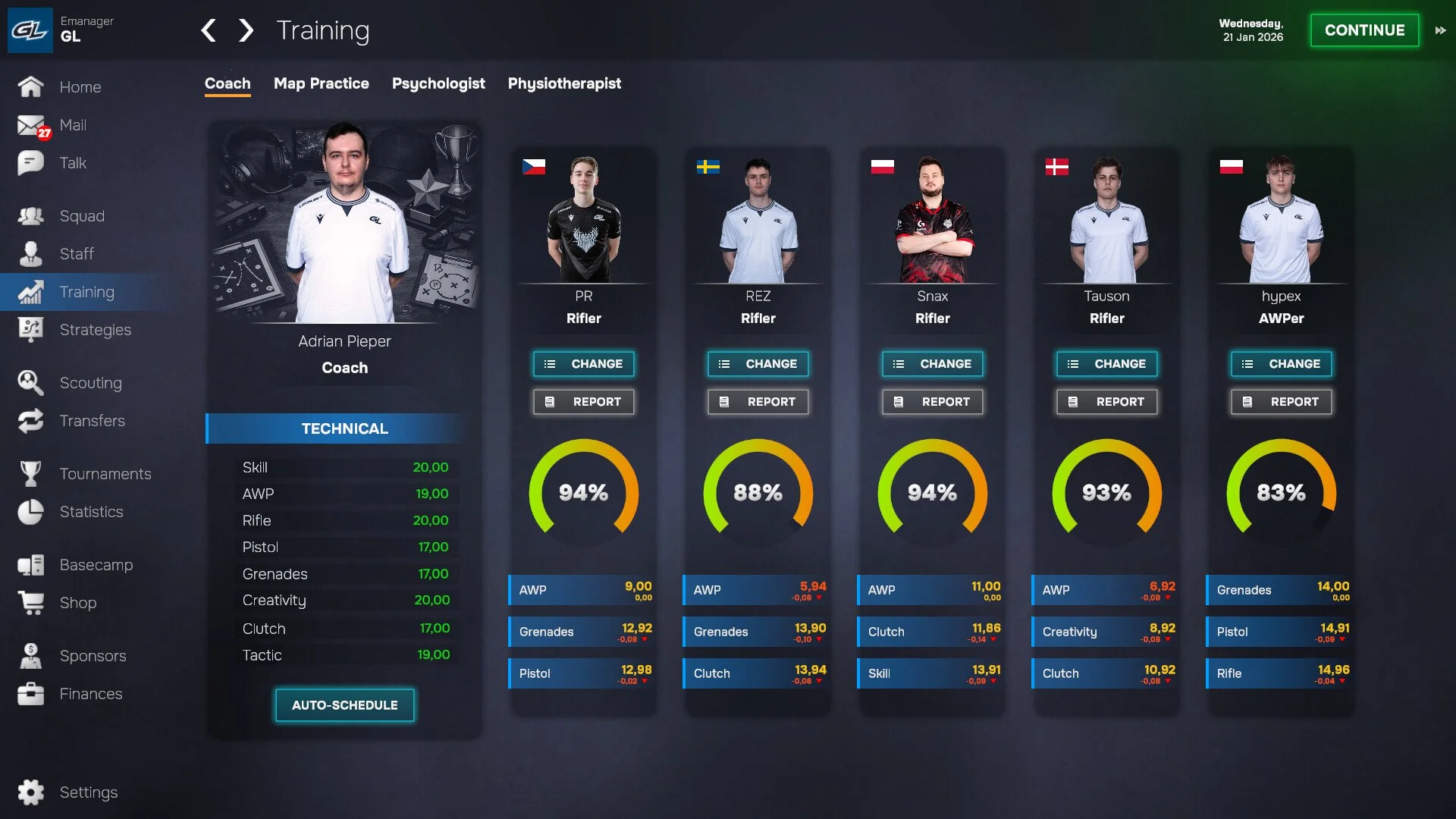
Auto Schedule is useful early because you do not know your players well enough yet to out-plan it. Once you start seeing who develops quickly, who struggles under workload, who needs morale support, and which maps are actually costing you matches, manual training starts to make more sense. Until then, letting the game handle the baseline is not lazy. It is just better than pretending you have a perfect read on a roster that has barely practiced together.
The more comfortable you get, the more training should connect to the calendar. If an event is coming up, train for the maps, tactics, and weaknesses that will actually matter there. Generic development has its place, but the best weeks are the ones that make the next match less chaotic.
How Important Is The Talk System?
The Talk system is worth using every week because it gives you a way to catch player problems before they turn into match results. If you only talk to players after the team starts losing, you are already late. Morale problems are much cheaper to fix when they are still conversations instead of losing streaks.
This system is easy to overlook because it does not feel as urgent as scouting or match day, but it affects the part of the game that quietly decides whether your roster holds together. Players have motivations, frustrations, and needs that are not always obvious from the stat screen. The Talk system is how you figure out what is happening under the surface before the whole thing starts leaking into performance.
Make it part of the same loop as training and finances. Check the schedule, check the budget, check the people. It sounds basic, but that is the management part of the game. You are not only building a lineup. You are keeping the lineup willing and able to perform.
When Should You Buy, Sell, Or Loan Players?
The transfer market rewards managers who move before they are desperate. Buying because you suddenly need a role filled is usually more expensive than planning ahead, and holding a player who no longer fits can quietly drain wages while giving you nothing in return.
Selling a player should not feel like failure if the player is not helping the team anymore. Sometimes the right move is turning a roster spot into money, especially if that player is blocking a better fit or sitting on wages that could be used somewhere else. Loans are also more useful than they look because they let you develop bench talent, cover short-term gaps, or avoid locking yourself into a long contract for a temporary problem.
The main habit is keeping some transfer flexibility before you need it. If the right player appears and your budget slider leaves you unable to act, that is not bad luck. That is planning badly and then being forced to watch someone else solve their roster with your missed opportunity.
How Should You Plan Around Tournaments?
The tournament calendar should guide your training, transfers, morale work, and expectations. Smaller events are not filler on the way to the Major. For a new org, they are how you build visibility, generate results, attract sponsors, and give your roster match experience before the stakes get heavier.
Do not treat the Major like something you are supposed to chase immediately just because it is the biggest goal on the calendar. Build toward it through smaller tournaments that your current roster can actually handle. Those events are where your org becomes real, and they are also where you find out which players, tactics, and preparation habits are going to survive tougher competition later.
The calendar is also where the game punishes sloppy timing. Selling a key player right before an event, changing tactics without enough practice, or ignoring morale before a dense stretch of matches can all make sense for about two clicks and then look terrible once the tournament starts.
Best First Save Plan
The best first save plan is to take over an existing team if you want a softer learning curve, then start a custom org once you understand how the systems connect. If you start from scratch right away, keep the opening month disciplined: hire an Analyst, scout by role, sign Free Agents, adjust your budget sliders, take small sponsor deals, use Auto Schedule until you know your roster, and make the Talk system part of your weekly routine.
That is the version of Esports Manager 2026 that becomes rewarding instead of overwhelming. The game is not really about one perfect signing or one perfect tactic. It is about keeping the loops working together: money supports the roster, the roster supports results, results support visibility, visibility supports sponsors, and sponsors let you build something better than the fragile little org you started with.
If I were starting over, I would not chase stars early unless the save practically handed me one. I would rather build a balanced, affordable roster that can train properly, keep morale stable, and win enough smaller events to make the next move obvious. The game gives you plenty of time to become reckless later. The first month is where you earn the right to do it.