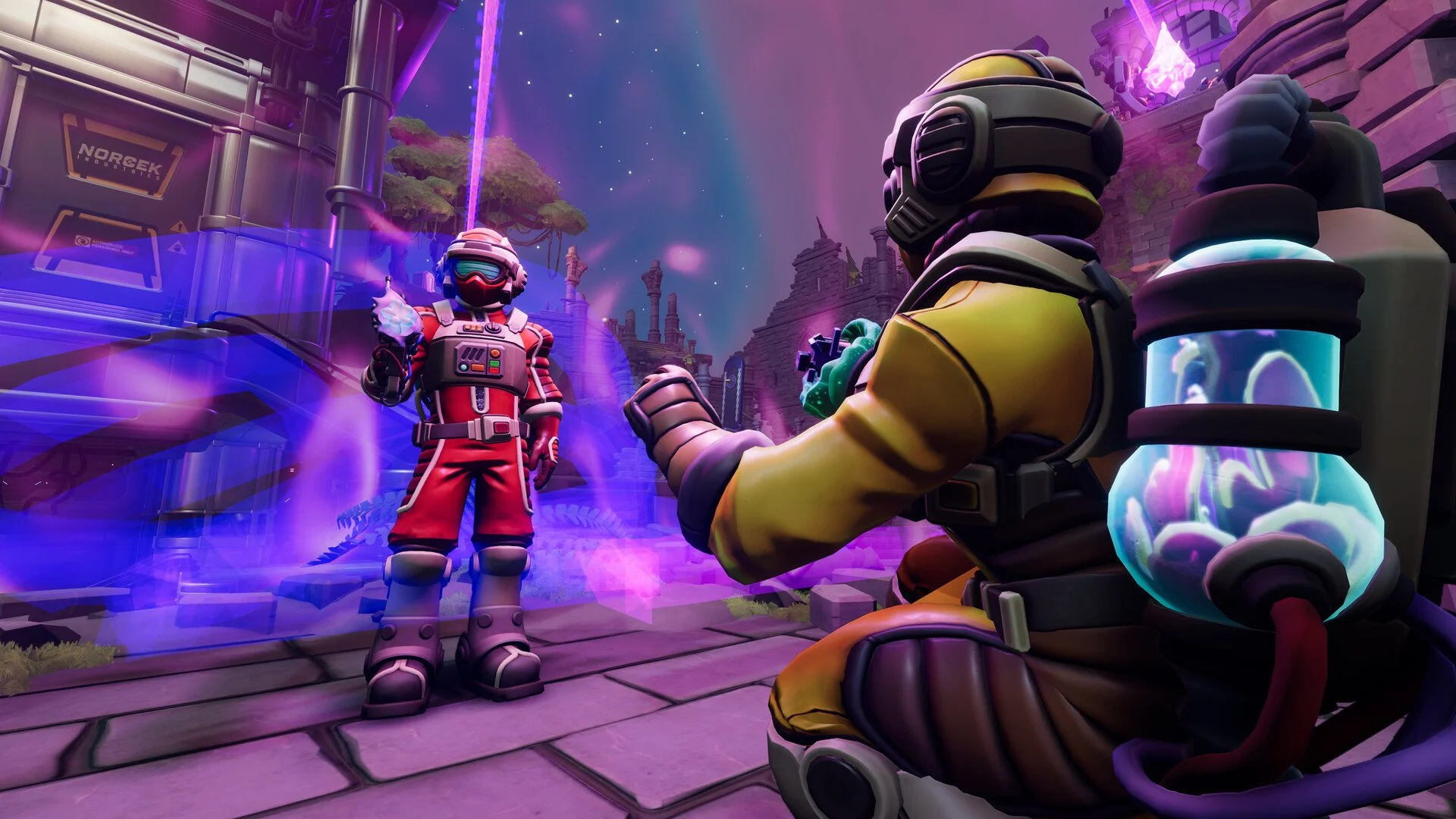
We Were Here Tomorrow Review
Few cooperative games have made conversation as rewarding as We Were Here. Across several installments, Total Mayhem Games has built an entire franchise around the simple pleasure of figuring something out with another person, turning incomplete information and questionable instructions into moments of genuine triumph. We Were Here Tomorrow takes that formula somewhere unfamiliar, abandoning the medieval castles and sinister corridors of its predecessors for an eccentric science-fiction adventure. The change brings inventive new mechanics, a striking visual identity, and a greater sense of scale, but it also exposes some weaknesses in a series that has traditionally thrived on keeping things simple.
An imaginative new direction with inventive cooperative puzzles, held back by inconsistent pacing and frustrating technical problems.
A New Direction for We Were Here
We Were Here Tomorrow begins with two Explorers stranded beneath the Antarctic ice during a rescue expedition. They awaken inside a mysterious research facility operated by Norček Industries, where a director named Kathleen Bowe recruits them to continue the work of a missing scientific team. The circumstances surrounding their arrival are uncertain, and the facility's increasingly unusual experiments provide the foundation for an adventure that gradually expands beyond its initial predicament.
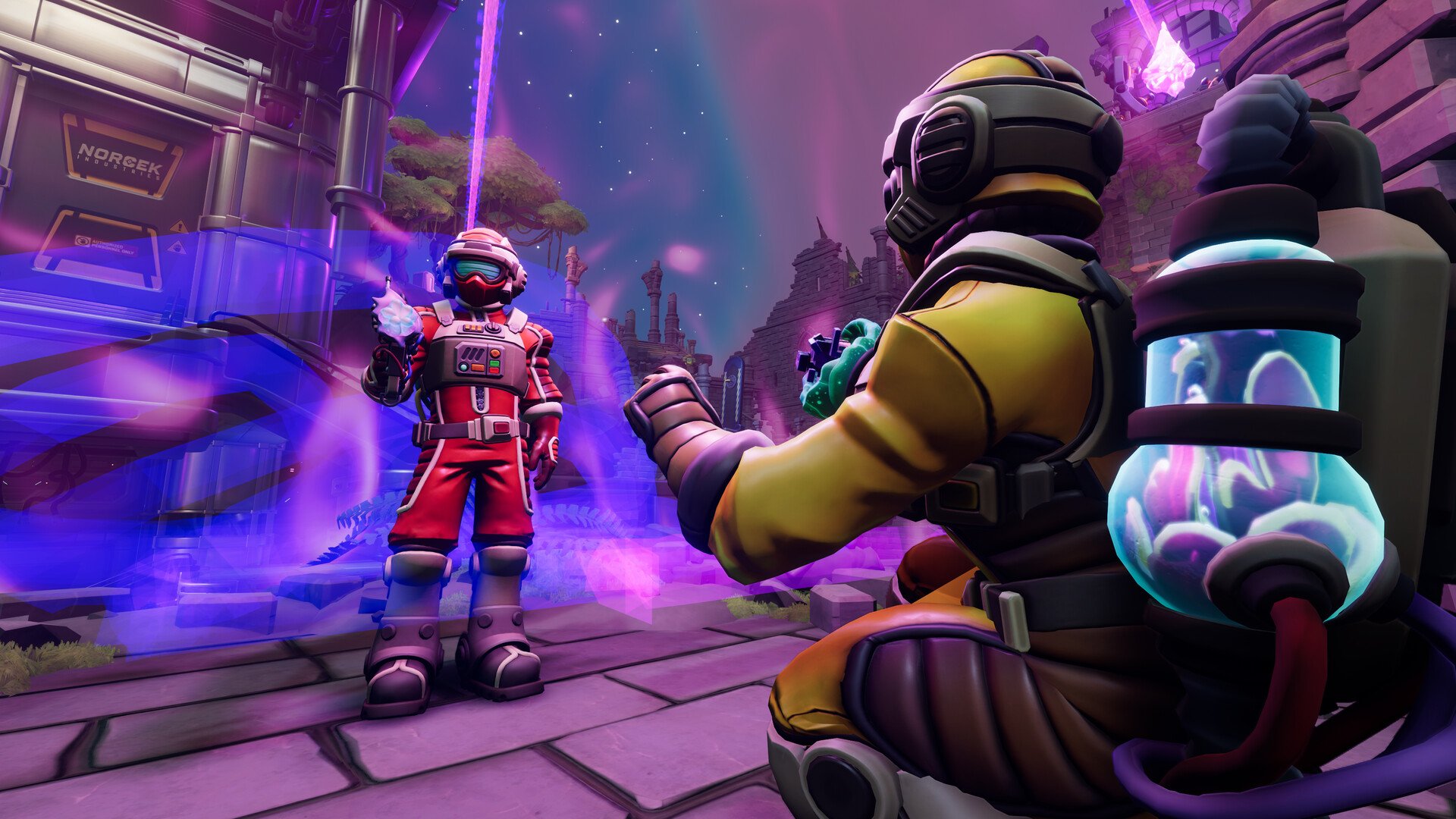
The premise marks a substantial departure from the medieval fantasy that has defined the series. Instead of navigating gloomy castles and ancient machinery, the Explorers find themselves surrounded by retro-futuristic laboratories, colorful scientific equipment, and technology that resembles an imagined future from the 1980s. It is an unusual but welcome transformation, giving the franchise an opportunity to develop a new identity without abandoning the cooperative puzzles at its center.
Norček Industries is an appealing setting for this kind of adventure. Its exaggerated machinery and peculiar environments encourage curiosity, while the mystery surrounding the facility gives players a reason to investigate beyond the immediate task of solving another puzzle. The brighter aesthetic also makes Tomorrow feel more playful than its predecessors, with a greater emphasis on scientific experimentation than supernatural unease.
That distinction is both refreshing and occasionally disappointing. The oppressive atmosphere of earlier We Were Here games contributed significantly to their identity, making each abandoned room and unexplained mechanism feel like another piece of an unsettling mystery. Tomorrow exchanges some of that tension for spectacle and humor, resulting in an adventure that is more visually adventurous but less consistently atmospheric.
Nevertheless, the decision to move beyond Castle Rock is difficult to fault. A series built around discovery cannot continue relying on the same environments indefinitely, and the science-fiction setting provides a convincing foundation for new ideas. Tomorrow may not always capture the particular charm of its predecessors, but its willingness to establish a different identity is one of its more admirable qualities.
The Cooperative Formula Remains Compelling
Despite the dramatic change in setting, We Were Here Tomorrow retains the asymmetrical cooperative gameplay that distinguishes the series from conventional multiplayer puzzle games. Two players must navigate the facility together, frequently separated by physical barriers and dependent on information that only their partner can access. Progress requires careful observation, precise communication, and a willingness to reconsider assumptions when an otherwise sensible instruction produces the wrong result.
The brilliance of this arrangement lies in how naturally it creates challenges that would barely exist in a single-player game. Understanding a mechanism is only half the task; explaining it to someone who cannot see the same information introduces an entirely different kind of problem. A description that seems perfectly reasonable to one player can be almost meaningless to the other, forcing both participants to develop a shared understanding before making progress.
Tomorrow builds on that foundation by giving each Explorer a different piece of specialized equipment. These tools introduce new ways to interact with the environment and establish distinct responsibilities within certain puzzles. Rather than relying exclusively on verbal descriptions of symbols, patterns, and machinery, the game incorporates more elaborate physical interactions that require both players to understand how their abilities complement each other.
The expanded mechanics give the cooperative experience a broader range of possibilities. Gravity manipulation and unconventional spatial puzzles introduce situations where changing the environment becomes as important as interpreting the information within it. These additions help distinguish Tomorrow from earlier installments, particularly when a puzzle requires both players to coordinate their actions rather than simply exchange instructions.
There is, however, a meaningful difference between expanding a formula and improving it. We Were Here has traditionally been at its strongest when communication is the primary obstacle, rewarding players for reaching a shared conclusion through observation and deduction. Tomorrow sometimes shifts that emphasis toward environmental manipulation and mechanical execution, making individual actions more elaborate without necessarily demanding the same degree of collaborative reasoning.
The distinction becomes apparent in puzzles where the necessary solution is less demanding than the process of carrying it out. Additional machinery and unusual movement mechanics can make a challenge more visually impressive, but the satisfaction of solving it still depends on whether the players have been asked to think together in an interesting way. Tomorrow's best ideas understand that relationship, while its less successful sequences occasionally mistake increased complexity for greater depth.
Creative Puzzles That Struggle With Pacing
We Were Here Tomorrow takes a more ambitious approach to puzzle design than its predecessors, introducing gravity manipulation, specialized equipment, and environmental challenges that demand more physical cooperation. The expanded mechanics give the adventure a welcome sense of variety, although they also expose some weaknesses in how its challenges are paced.
The opening portion is particularly conservative, relying on relatively simple puzzles to establish the rules of its new systems. There is value in giving players room to experiment, especially when both participants are learning different mechanics, but the introductory stretch lacks some of the satisfying complexity that made the earlier games so rewarding. The difficulty increases as more systems enter the equation, allowing the cooperative elements to become more involved and demanding.
Gravity manipulation is among the more distinctive additions, transforming familiar environments into spatial puzzles where walls and ceilings take on entirely different functions. The concept provides some of Tomorrow's most interesting opportunities for experimentation, but the extended reliance on changing orientation eventually diminishes its novelty. What begins as a clever departure from traditional puzzle-solving can become a repetitive exercise in navigating the same underlying mechanic.
These sequences also introduce an unfortunate physical consideration, as repeated changes in orientation can cause discomfort for players susceptible to motion sickness. It's a limitation that feels particularly significant when the affected mechanics occupy substantial portions of the adventure rather than appearing as occasional diversions.
The larger issue is one of restraint. Tomorrow has no shortage of ideas, but not every concept benefits from being developed into an extended sequence. Its most compelling puzzles preserve the series' emphasis on exchanging information and interpreting a partner's observations, while the weaker challenges place too much weight on mechanical execution. The result is a more varied cooperative adventure, though not always a more satisfying one.
Even with those inconsistencies, the expanded approach has merit. The stronger challenges demonstrate how effectively the series can incorporate new mechanics without abandoning its identity, and the increasing complexity gives experienced players more to consider once the introductory sections are behind them. Tomorrow is not lacking in imagination; it simply would have benefited from a more disciplined approach to how that imagination is distributed throughout the experience.
A Striking World With a Different Personality
The shift to science fiction gives We Were Here Tomorrow its most immediately recognizable quality. Norček Industries embraces a retro-futuristic aesthetic filled with stylized machinery, vivid environments, and scientific contraptions that look as though they belong in an eccentric interpretation of the future. The visual direction is colorful without abandoning the underlying sense of mystery, and the facility provides an appealing backdrop for the increasingly elaborate puzzles.
There is a deliberate playfulness to the environments that separates Tomorrow from the gloomy fantasy architecture of earlier installments. Strange technological apparatus and unusual experimental spaces invite exploration, while the broader setting offers more opportunities for visual variety than another succession of chambers within a medieval castle.
The soundtrack complements that transformation, drawing on electronic and synthwave influences to reinforce the game's particular interpretation of science fiction. It establishes a distinctive atmosphere that feels well suited to the facility's unusual technology, helping give the adventure a recognizable identity beyond the mechanics of its puzzles.
The presentation is not entirely consistent, however. Some environments rely on relatively simple geometry and sparse surface detail, creating a contrast between the ambition of the overall artistic direction and the execution of individual assets. The stylization generally works in the game's favor, but certain areas lack the polish needed to make the facility feel as convincing as its strongest environments.
Tomorrow also places greater emphasis on its narrative, using Kathleen Bowe and the mystery surrounding Norček Industries to connect its puzzles within a larger story. Rather than presenting each challenge as another obstacle in an extended escape sequence, the game gives its scientific experiments a more deliberate role in the adventure's premise.
That expanded storytelling creates additional context for exploration, although it occasionally competes with the pace of the cooperative gameplay. Longer animations and more elaborate narrative sequences can interrupt the momentum of moving between challenges, particularly when the central appeal lies in experimenting with the environment and communicating with a partner.
The stronger presentation ultimately represents a worthwhile evolution, even if the increased emphasis on spectacle cannot entirely replace the atmosphere that distinguished earlier entries. Tomorrow establishes a world with considerable personality, but the series' most memorable moments still emerge from the interactions between its players rather than the scenery surrounding them.
Technical Problems Strike at the Heart of the Experience
For a game built almost entirely around communication, reliable voice chat should be among its most dependable features. Unfortunately, We Were Here Tomorrow's launch has been complicated by problems affecting precisely that system, with walkie-talkies becoming inaccessible, microphones unexpectedly losing functionality, and communication occasionally breaking down during active sessions.
These issues are considerably more disruptive than ordinary multiplayer inconveniences. Voice communication is fundamental to the way We Were Here functions, and losing the ability to exchange information can bring an otherwise enjoyable puzzle to a complete halt. Restarting a session to recover a malfunctioning radio is frustrating in any cooperative game, but especially in one where uninterrupted conversation is central to the experience.
The problem is compounded by Tomorrow's use of proximity-based communication alongside its familiar walkie-talkies. The distinction between speaking to someone nearby and contacting a separated partner provides another layer to the cooperative design, allowing physical distance to influence how players interact. Switching to Discord or another external application can bypass the immediate problem, but it also diminishes an element of the experience that the developers have deliberately incorporated into the gameplay.
Other technical issues further undermine the consistency of the adventure. Objects can occasionally behave unpredictably between puzzle areas, certain interactions can leave progression in an awkward state, and crashes or performance interruptions introduce additional opportunities for frustration. These problems are not necessarily encountered in every session, but their presence is particularly unwelcome in a game that depends on two players maintaining a shared sense of progress.
Technical shortcomings are easier to forgive when they affect secondary systems or isolated visual details. Tomorrow's most concerning problems interfere directly with its defining mechanic, turning the act of communicating with a partner into something that cannot always be taken for granted.
The underlying cooperative design remains compelling, but its effectiveness depends on a level of reliability that the launch experience has not consistently delivered. No amount of inventive puzzle design can fully compensate for communication failures that prevent players from engaging with those puzzles as intended.
More Ambitious Does Not Always Mean More Rewarding
At a standard price of $19.99, We Were Here Tomorrow offers a substantial cooperative adventure compared with the shorter experiences that helped establish the franchise. Total Mayhem Games has promoted approximately 15 hours of content, making this the largest installment in the series and reflecting its greater emphasis on elaborate environments, specialized equipment, and an expanded narrative.
The increased scope is appealing, but puzzle games are particularly sensitive to the relationship between length and quality. Their value is rarely determined by the number of hours required to reach the ending, since much of the enjoyment comes from the originality of individual challenges and the satisfaction of solving them. A concise puzzle can leave a stronger impression than an elaborate sequence that continues after its central idea has been thoroughly explored.
Tomorrow demonstrates both sides of that relationship. Its expanded mechanics provide opportunities for challenges that earlier installments could not have supported, while the uneven pacing makes some portions feel longer than their ideas justify. The additional content is valuable when it introduces a genuinely new form of cooperation, but less so when familiar interactions are repeated without substantially changing how players approach them.
The purchasing arrangement is another consideration. We Were Here Tomorrow requires two participants, and each needs a separate copy of the game. Without a standard Friend's Pass, two newcomers purchasing the adventure together face a combined standard price of $39.98, making the initial commitment more significant than the individual price might suggest.
Asymmetrical puzzles provide some incentive to revisit the adventure from the opposite player's perspective, although familiarity with the solutions inevitably reduces the sense of discovery. Like most games built around carefully designed puzzles, Tomorrow derives much of its appeal from a first playthrough in which neither participant knows what to expect.
For established fans, the larger adventure and expanded cooperative mechanics offer a convincing reason to return. Newcomers may find the asking price reasonable as well, provided they have a committed partner and are comfortable with the possibility of encountering technical problems. Ultimately, the question is not whether Tomorrow contains enough content to justify its price, but whether its best ideas remain engaging throughout the experience.
We Were Here Tomorrow Review Verdict
We Were Here Tomorrow is an ambitious evolution of a cooperative formula that has distinguished Total Mayhem Games for years. Its imaginative science-fiction setting, specialized player equipment, and increasingly elaborate environmental puzzles demonstrate a willingness to experiment with the franchise's established identity. The result is a more varied adventure that retains the fundamental satisfaction of two people working through problems neither could solve alone.
That ambition is not always matched by the execution. The difficulty fluctuates considerably, certain mechanics overstay their welcome, and the greater emphasis on physical interactions occasionally weakens the communication-driven puzzle design that made the earlier games so compelling. The brighter atmosphere also lacks some of the tension and character of the series' medieval settings, even as it establishes a distinctive world of its own.
The technical problems are harder to overlook. Unreliable voice communication strikes directly at the experience's greatest strength, and the need to work around malfunctioning radios or interrupted sessions can undermine the satisfaction of otherwise enjoyable challenges. These shortcomings are particularly frustrating because they interfere with systems that should provide the foundation for everything else.
Yet there is considerable merit in Tomorrow's attempt to move the series forward. Its strongest ideas demonstrate how much potential remains in asymmetrical cooperative puzzle-solving, while the new setting provides a refreshing alternative to the familiar environments of previous installments. Not every experiment succeeds, but the willingness to attempt something different gives the adventure a distinct identity.
We Were Here Tomorrow is a worthwhile addition for fans who want to experience the series through a different lens, though its uneven pacing and troublesome launch make it a more qualified recommendation than its ambitions deserve. Total Mayhem Games has found an imaginative direction for the franchise, but the next step should be refining the experience rather than simply expanding it. Tomorrow proves there is plenty of life left in We Were Here's cooperative formula, even if this particular journey does not always make the most of it.
Reviewed by Alec Braun