Farever Mage Guide: Spark, Skills, And Best Build
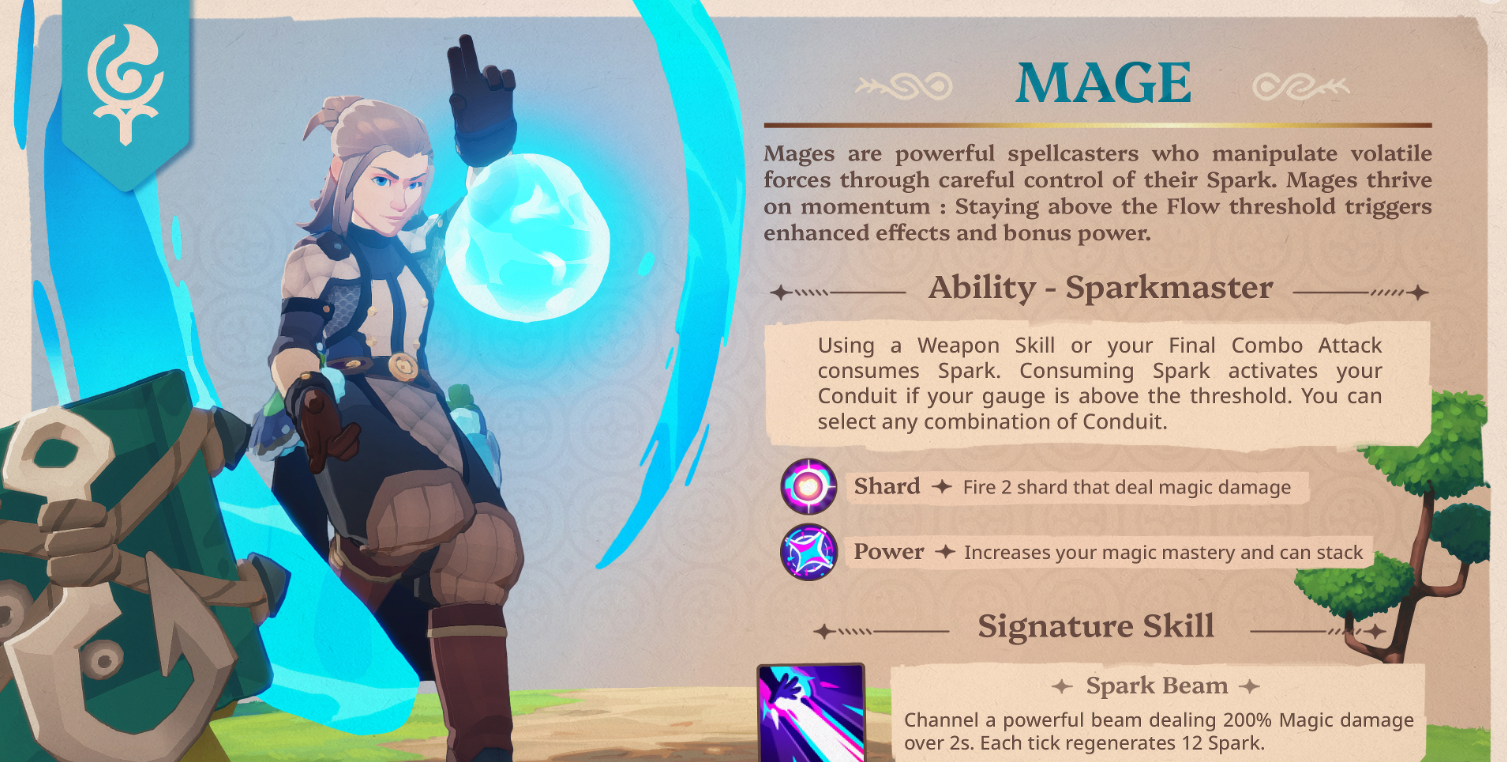
Mage in Farever is the spellcaster class built around Spark, Conduits, Chaincast, magic damage, mobility, and party utility. The best Mage build focuses on keeping Spark flowing, staying above the Flow threshold, triggering Conduits, and using the skill tree to support either Spark damage, hybrid attacks, or healing utility.
For the full early access guide list, use the Farever guides hub.
Jump To
Best Mage Build In Farever
The best Mage build in Farever is a Spark focused caster setup that uses Chaincast, Spark recovery, Conduit triggers, and Magic Mastery scaling to keep damage active instead of running dry after every spell cycle.
Mage is built around momentum. Spark is the engine, Conduits are the payoff, and Chaincast gives the class another layer of burst and rhythm. The Root node unlocks Chaincast, which triggers after using 4 Skills within the required window and lasts for 10 seconds. That makes Mage stronger when skills are chained together cleanly instead of used randomly.
The safest current Mage direction is still a Spark focused magic damage build. The best early tree path should prioritize Root for Chaincast, Spark recovery options like Infinite Resources, Prodigious Mind, Expanded Spirit, and Conduit support like Reverberate or Spark Explosion once enough points are available.
This is not a final solved endgame meta build, because Farever’s full gear balance and best weapon setups can still shift. The reliable core is clear though. Mage wants Spark generation, Spark spending above the Flow threshold, Conduit value, and enough mobility or safety to keep casting without getting folded like a robe with opinions.
How Mage Works In Farever
Mage is Farever’s spellcaster class, using Spark to trigger Conduits and Chaincast to reward fast skill usage.
The class is built around controlled spell momentum. Mage wants to use weapon skills or final combo attacks to consume Spark, then trigger Conduit effects if the Spark gauge is above the Flow threshold. The skill tree adds more ways to support that loop through Spark recovery, cooldown reduction, extra Conduit triggers, and Chaincast bonuses.
Mage has a more technical feel than Warrior or Rogue. Warrior spends Rage for melee impact. Rogue builds Combo Points and cashes them in with Finisher. Mage manages Spark, Conduits, Flow threshold timing, and Chaincast windows, which gives the class more of a spell engine identity.
For a full look at every launch class, the Farever Classes Guide covers Warrior, Rogue, Mage, and Cleric together.
How Spark Works For Mage
Spark is the Mage’s main resource, consumed by weapon skills or final combo attacks to activate Conduits when the gauge is above the Flow threshold.
This is the core Mage system. Spark is not only a resource bar that gets spent on damage. It controls when Conduits can activate, which means Mage wants to keep enough Spark available before spending it. Dropping below the Flow threshold at the wrong time weakens the class’s rhythm.
The new skill tree reinforces this with several Spark focused nodes. Infinite Resources regenerates 2 Spark every 3 seconds while in combat. Prodigious Mind gives weapon skills a chance to recover 25 percent of their Spark cost. Expanded Spirit increases maximum Spark by 10 points. Spark Flask makes Refillable Flask regenerate 10 Spark points.
| Mage Resource Tool | How It Helps |
|---|---|
| Spark | Consumed through weapon skills or final combo attacks. |
| Infinite Resources | Regenerates 2 Spark every 3 seconds while in combat. |
| Prodigious Mind | Weapon skills have a chance to recover 25 percent of their Spark cost. |
| Expanded Spirit | Increases maximum Spark gauge by 10 points. |
| Spark Flask | Refillable Flask regenerates 10 Spark points. |
The mistake is treating Spark like something to dump instantly. Mage is stronger when Spark is managed around the Flow threshold, Chaincast windows, and Conduit triggers.
Chaincast Explained
Chaincast is unlocked from the Mage Root node and triggers after using 4 Skills within the required window, granting Chaincast for 10 seconds.
This makes Root the first required point before the rest of the Mage tree opens. The Root point unlocks the whole tree, but it does not count toward tier requirements. That means every build starts by unlocking Chaincast, then spends points into one or more branches.
Chaincast matters because several Mage nodes gain value from it. Reverberate makes consuming Chaincast trigger Conduits twice. Chainstrike increases attack damage while under Chaincast. Kinetic Surge makes Chaincast increase the physical damage of the next weapon skill. High Voltage makes combo attacks always critically strike while under Chaincast.
| Chaincast Node | Effect |
|---|---|
| Root | Using 4 Skills within the required window grants Chaincast for 10 seconds. |
| Reverberate | Consuming Chaincast triggers Conduits twice. |
| Chainstrike | Attacks deal increased damage while under Chaincast. |
| Kinetic Surge | Chaincast increases the physical damage of the next weapon skill. |
| High Voltage | Combo attacks always critically strike while under Chaincast. |
For a pure caster setup, Reverberate is the standout because it directly improves Conduit value. For hybrid builds, the middle branch has more attack and physical scaling tools.
Mage Skill Tree Branches
The Mage tree has 3 main directions after Root: a Spark and Conduit branch, a hybrid attack branch, and a healing utility branch.
The left branch is the cleanest choice for a Spark focused Mage. It includes Reverberate, Temporal Compression, Infinite Resources, Prodigious Mind, Expanded Spirit, and Conduit: Spark Explosion. This path supports Spark uptime, weapon skill flow, cooldown reduction, and extra Conduit payoff.
The middle branch is better for hybrid Mage setups that care about attacks, combo attacks, and physical scaling. Discipline increases Magic Mastery by 5 percent and increases Physical Mastery by 50 percent of Magic Mastery. That gives Mage a clear hybrid bridge instead of locking the class into pure spell damage only.
The right branch leans into sustain and support. Conduit Residues can regenerate Spark when Conduits trigger, Life Current can grant Chaincast from healing effects, Echoing Life improves the next healing weapon skill after Chaincast, Flowing Vitality heals based on Spark spent, and Conduit: Lifebolt adds a healing Conduit.
| Branch | Main Focus | Best Fit |
|---|---|---|
| Left Branch | Spark, cooldowns, Conduit damage, Spark Explosion. | Best general Mage damage path. |
| Middle Branch | Magic Mastery, attacks, combo attacks, hybrid scaling. | Best for hybrid weapon skill Mage builds. |
| Right Branch | Spark recovery, healing, Lifebolt, support value. | Best for sustain and party utility Mage builds. |
For most players, the left branch should be the safest starting point because it directly improves the Mage’s main class loop. The middle and right branches look more specialized, but they can make sense once weapon choices and group needs are clearer.
Mage Conduits Explained
Conduits are Mage effects that activate when Spark is consumed while the gauge is above the Flow threshold.
The shown class Conduits include Shard and Power, while the skill tree adds deeper Conduit options like Spark Explosion and Lifebolt. Spark Explosion deals 25 percent Intellect Magic to nearby enemies when Spark is consumed above the gauge threshold. Lifebolt heals the nearest wounded ally for 25 percent Intellect when Spark is consumed above the gauge threshold.
| Conduit | Effect | Best Use |
|---|---|---|
| Shard | Fires 2 Shards that deal magic damage. | Extra direct magic damage. |
| Power | Increases magic mastery and can stack. | Scaling magic output over time. |
| Conduit: Spark Explosion | Explodes for 25 percent Intellect Magic to nearby enemies. | Area damage around the Mage. |
| Conduit: Lifebolt | Heals the nearest wounded ally for 25 percent Intellect. | Support and group sustain. |
Reverberate is especially important for Conduit builds because consuming Chaincast triggers Conduits twice. That makes the left branch valuable for players who want Mage to hit harder through the class mechanic instead of only relying on weapon skill damage.
Spark Beam Explained
Spark Beam is the Mage’s signature skill, channeling a beam that deals 200 percent magic damage over 2 seconds and regenerates 12 Spark on each damage tick.
This is the Mage’s main signature payoff and recovery tool. Spark Beam is not only damage. The Spark regeneration makes it part of the class’s resource loop, helping Mage rebuild Spark after spending it through weapon skills or final combo attacks.
| Spark Beam Detail | Confirmed Value |
|---|---|
| Damage | 200 percent magic damage over 2 seconds. |
| Resource Effect | Each damage tick regenerates 12 Spark. |
| Best Use | Magic burst, Spark recovery, and keeping the Mage spell loop active. |
Spark Beam should be used when Mage can safely channel and benefit from Spark return. It ties the class together because it pushes damage while helping rebuild the resource needed for more Conduit triggers.
Mage Skills And Combat Tools
Mage has confirmed magic damage, resource recovery, mobility, and party buff tools through Spark Beam, Blink, Mystic Empowerment, Spark focused tree nodes, and Conduit unlocks.
Blink is the Mage’s teleport tool. It acts as a standard teleport, giving Mage a way to reposition quickly. That matters because Mage is built around casting and resource timing, and bad positioning can ruin that flow fast.
Mystic Empowerment gives Mage strong party value. It boosts party magic mastery by 20 percent for 15 seconds, which makes Mage useful beyond personal damage. In groups with other magic users or magic focused builds, that buff can become a major reason to bring Mage.
| Skill | Effect | Best Use |
|---|---|---|
| Spark Beam | Deals 200 percent magic damage over 2 seconds and regenerates 12 Spark on each damage tick. | Main signature skill for damage and Spark recovery. |
| Blink | Acts as a standard teleport. | Repositioning, avoiding danger, and keeping spell flow safe. |
| Mystic Empowerment | Boosts party magic mastery by 20 percent for 15 seconds. | Increasing group magic output during damage windows. |
These tools make Mage more than a simple ranged damage pick. Spark Beam keeps the class engine running, Blink helps protect positioning, and Mystic Empowerment gives the party a strong magic damage window.
Mage Party Utility And Group Value
Mage brings party utility through Mystic Empowerment, Lifebolt options, and healing focused tree nodes if the right branch is chosen.
Mystic Empowerment increases party magic mastery by 20 percent for 15 seconds. That gives Mage a clear role in group play because the buff can be timed with active spell pressure, boss damage windows, or heavy enemy phases.
The right branch can push Mage further toward support. Life Current gives healing effects a chance to grant Chaincast, Echoing Life improves the next healing weapon skill after Chaincast, Flowing Vitality heals Mage while spending Spark, and Conduit: Lifebolt heals the nearest wounded ally.
That does not mean every Mage should become a healer. It means Mage has a real support route if the party needs it, while the damage route still lives mainly in Spark, Chaincast, and Conduit pressure.
Mage Weapons And Arsenal Build Choices
Mage weapon choice matters because Farever weapons have their own movesets, unique skills, skill leveling, and Arsenal value.
This is especially important for Mage because Spark can be consumed through weapon skills or final combo attacks. That means weapon choice can affect how smooth the Sparkmaster loop feels. A weapon with useful skills and a comfortable combat rhythm can help Mage trigger Conduits more reliably and keep Spark moving.
A main weapon should support the Mage’s active combat flow. An Arsenal weapon can add skills to the skill bar, which gives Mage more room to shape a build around damage, mobility, support, or utility.
| Build Goal | Mage Weapon Priority |
|---|---|
| Magic Damage | Weapons that support Spark spending, Conduit triggers, and strong spell pressure. |
| Conduit Flow | Weapons with skills that make it easier to spend Spark above the Flow threshold. |
| Party Utility | Weapons that pair well with Mystic Empowerment and group damage windows. |
| Hybrid Caster | A main weapon for spell flow plus an Arsenal weapon for extra utility or damage skills. |
The best Mage build should not chase raw upgrades without checking the weapon skill package. Mage depends on rhythm. A weapon that interrupts Spark flow or gives awkward skill timing may feel worse than one with smoother Conduit support.
Mage Tips For Better Combat
Mage gets stronger when Spark, Chaincast, Conduits, and positioning are managed together. The class rewards momentum, but that momentum needs clean timing.
- Unlock Root first. Root opens the Mage tree and gives Chaincast after using 4 Skills within the required window.
- Prioritize Spark tools early. Infinite Resources, Prodigious Mind, and Expanded Spirit all help the Mage loop stay active.
- Use Reverberate for Conduit builds. Triggering Conduits twice from Chaincast consumption is a major payoff.
- Stay above the Flow threshold before spending Spark. Conduits need Spark consumption above the threshold to activate.
- Use Spark Beam for both damage and recovery. Spark Beam deals 200 percent magic damage over 2 seconds and regenerates 12 Spark on each tick.
- Use Blink before positioning gets bad. Teleporting early keeps the Mage spell loop cleaner than escaping after pressure has already ruined the cast plan.
- Time Mystic Empowerment with group damage. The 20 percent party magic mastery boost lasts 15 seconds, so it should line up with active damage windows.
The main mistake is playing Mage like a basic ranged class. Mage wants to manage Spark, trigger Conduits, build Chaincast windows, channel Spark Beam at useful moments, and keep safe enough to maintain the loop.
Best Mage Gear Upgrades
The best Mage gear upgrades should support magic damage, Spark flow, and survival, with the main weapon being the first upgrade priority when it improves damage or unlocks useful weapon skills.
Mage benefits heavily from weapon upgrades because weapon skills are connected to Sparkmaster. Using weapon skills consumes Spark, and consuming Spark above the Flow threshold activates Conduits. That means the weapon is not only a damage source. It also affects how smoothly the Mage build triggers its class mechanic.
For solo play, defensive upgrades become more important because Mage is not built to absorb pressure like a front line class. Extra survivability helps keep Spark Beam channels and Conduit timing from getting interrupted by every enemy that decides personal space is fake.
Final Blurb
Mage in Farever is the best fit for players who want magic damage, Spark management, Chaincast timing, Conduit choices, and party utility. Root gives the class Chaincast, Spark tools keep the engine running, and Conduits decide whether the build leans into damage, hybrid pressure, or support.
The best Mage build is a Spark focused caster setup built around staying above the Flow threshold, using Chaincast cleanly, choosing useful Conduits, and using Spark Beam to keep the resource cycle moving. Mage should reward clean spell flow more than panic casting, which is unfortunate for panic casters but excellent for everyone else.