How Many Dudes Tips and Tricks
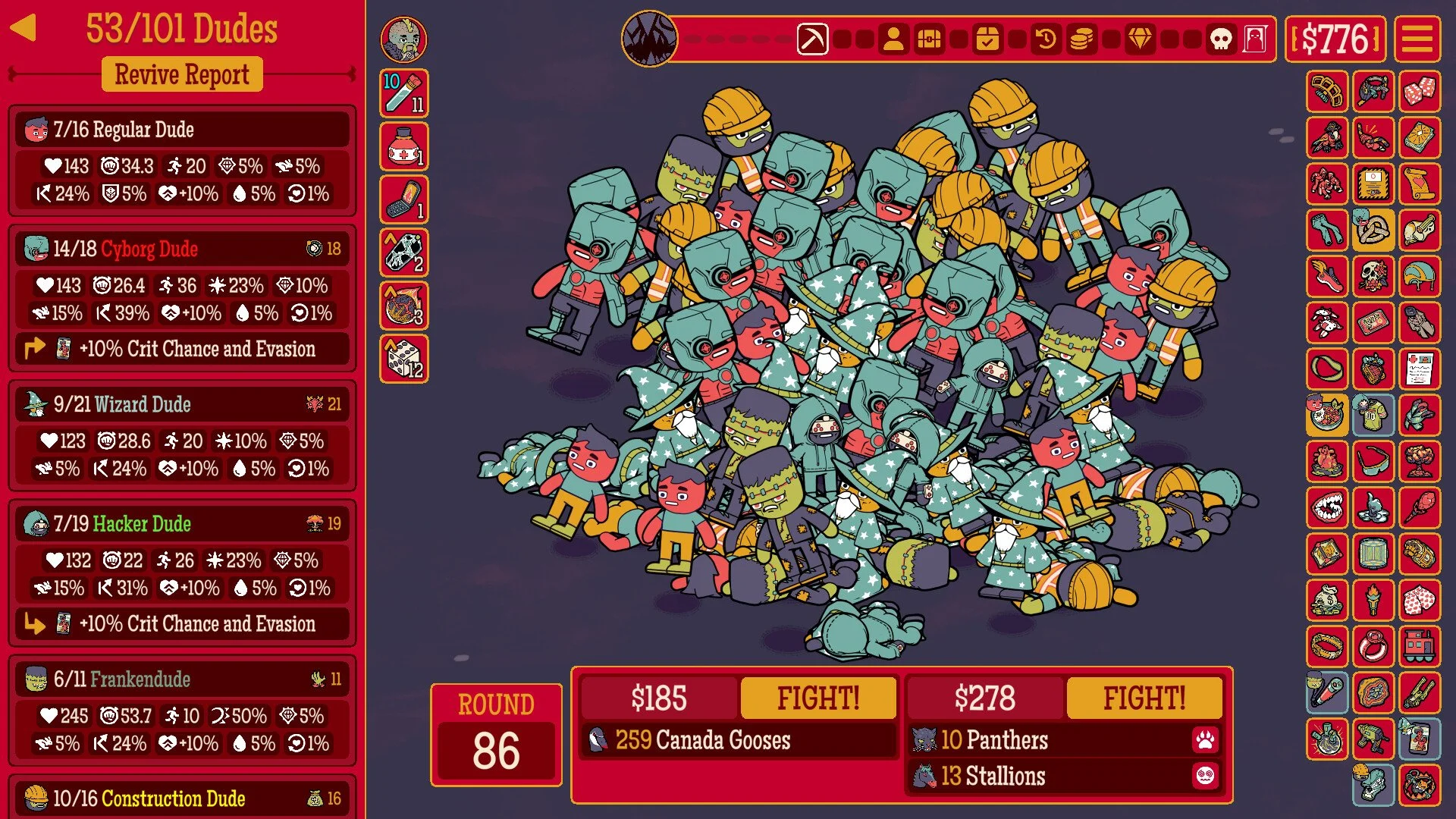
How Many Dudes? throws enough random choices at you that a failed run can easily feel like bad luck. Sometimes it genuinely is, particularly during the opening rounds, but most runs are decided by how well you adapt your economy and team before the difficulty begins exposing every weakness at once.
The best teams are not simply collections of powerful Dudes. They have enough healing to stabilize early losses, enough area damage to handle growing enemy counts, and enough toughness to stop fragile units from disappearing to late-game burst damage. These tips focus on building that foundation while leaving room to experiment with different compositions.
Jump To Section:
Surviving the Early Rounds
Money and Investments
Choosing the Right Round
Building a Balanced Team
Choosing Relics
Preparing for Endless
Common Mistakes
1. Treat the Opening Rounds as Damage Control
The first few rounds are more vulnerable to bad luck than the rest of a run. With only a handful of Dudes on the field, an uneven enemy spawn can place most of the pressure on one unit before your formation has enough bodies to spread that damage around.
Losing a Dude this early also has a larger effect than losing one later. Entering the next round with two units instead of three can create another uneven fight, which leads to another loss and begins a cycle that becomes increasingly expensive to repair.
Do not judge an entire strategy by one opening wipe. Sometimes the placement is simply too unfavorable. The useful question is whether the composition stabilized once it had enough units, not whether it could overcome every possible Round 2 formation.
2. Measure Purchases by the Losses They Prevent
Saving money is important, but refusing to spend anything can be just as damaging as buying too much. A small purchase that prevents several Dudes from being knocked out may save more than the amount you would otherwise spend replacing them with Dude Juice.
This is particularly important when comparing permanent upgrades with consumables. Consumables solve one immediate problem, while relics and investments improve every future round. You should usually favor permanent value, but not when doing so leaves the current team too weak to reach the next shop intact.
The strongest economy is not necessarily the run with the largest number displayed in the corner. It is the run that reaches later shops with enough money to keep investing and a team healthy enough that replacement costs have not consumed the profit.
3. Build Investments in Stages
A useful investment plan is to grow the account in several large steps rather than dumping every spare coin into it immediately. Rough targets such as moving from around 3,000 to 6,000, then 9,000 to 18,000, and eventually 20,000 to 40,000 provide a sense of how compounding money can support the late game.
Those numbers are guidelines rather than strict requirements. The right amount depends on what the current team needs and what the shop offers. If an important relic appears, skipping it solely to hit an arbitrary investment target can weaken the run more than the extra interest helps.
By the final stretch before Round 100, an investment in the 15,000 to 20,000 range may already be enough to finance most remaining relic purchases. Continuing to hoard beyond what you can realistically spend offers less value than completing the build that must survive the upcoming rounds.
4. Restock When the Shop Has a Real Chance to Help
There is no need to treat every restock as wasteful. An inexpensive early restock can be worthwhile when the team is missing healing, a defining relic, or the unit type needed to stop the run from collapsing.
The mistake is restocking without a specific target. Paying repeatedly because the first screen looks unexciting drains the same money that could have been invested or used on a permanent upgrade later.
Before rerolling, decide what result would justify the cost. If only one extremely specific option can save the run, the odds may not be worth chasing. If several healers, defensive units, or relics would improve the team, the restock has a much better chance of creating value.
5. Do Not Automatically Choose the Hardest Round
Harder rounds usually offer better rewards, but the reward difference matters less than the expected cost of surviving them. Earning an additional 50 coins is a poor trade if the round knocks out several Dudes and forces you to spend hundreds restoring the team.
Compare the enemy type, quantity, and reward before making the choice. A wave with fewer dangerous enemies may be much worse for your particular team than a larger group of weaker targets, especially if your composition already has strong area damage.
The correct path is the one that produces the highest net gain after casualties and items are considered. As you learn the matchups, you will become better at recognizing which apparently difficult rounds your team can clear cheaply and which modest-looking waves attack its exact weakness.
6. Use Consumables to Stop Losses From Compounding
Dude Juice and other consumables should provide a safety net, not become the foundation of the economy. Keeping one Juice available, or two or three when the team is unstable, gives you room to recover from an unlucky fight without spending heavily at every shop.
Free consumables are particularly valuable because they allow you to solve a dangerous round without reducing the money available for relics and investments. Learn what each one can realistically prevent rather than saving every item for a hypothetical emergency that never arrives.
The best time to use an item is usually before the run enters a death spiral. Restoring a few important units and entering the next round at full strength is cheaper than allowing each weakened wave to create additional casualties.
7. Build for the Next Phase, Not the Final Screenshot
A team capable of reaching Round 120 is not necessarily assembled in its final form during the first shop. Early survival, mid-game crowd control, and Endless durability are separate problems, and each becomes important at a different point.
The opening should prioritize healing and enough durability to keep the team from bleeding money through constant knockouts. Around Round 20, growing enemy counts make reliable area damage more important. By roughly Round 40, larger individual hits begin exposing Dudes that have damage but little protection.
Thinking in phases prevents you from taking a late-game specialist too early and then wondering why the run cannot reach the point where that unit becomes useful.
8. Concentrate Your Early Dude Counts
Spreading early selections across too many unit types creates a team with plenty of ideas but very little consistency. A small number of each Dude may not activate their best scaling often enough to carry a difficult round.
Focusing the first major group around a healer is one reliable approach. Building roughly 10 to 15 healers can create enough consistency to stabilize incoming damage before you begin investing heavily in a second role.
From there, add a Dude that contributes protection to the entire team or solves the next major weakness. This creates a core that functions every round rather than several incomplete combinations waiting for the correct relics.
9. Choose Roles Before Choosing Specific Dudes
A balanced team generally needs healing, protection against burst damage, a way to handle large enemy groups, and damage that continues scaling as the rounds become longer. Thinking in those roles gives you more flexibility than deciding in advance that the run must contain five exact Dudes.
Medic, Cleric, Ghost, and Vampire may all contribute healing, but they do not provide it in identical ways. Paladin and Bard can both improve team survival through toughness, yet they require different support and investment. Viking brings self-sustain and offensive buffs that reduce how much attention the healers must spend on it.
When the shop refuses to offer your preferred composition, look for another Dude that performs the missing job. A run becomes far less dependent on perfect RNG once you understand which roles are interchangeable and which combinations actually rely on one specific interaction.
10. Do Not Treat Necro as Mandatory
Necro is extremely effective before Endless because it offers summons, damage, distraction, and useful interactions with several other units. A strong Skeleton setup can carry a run through sections that would overwhelm a less developed team.
The weakness appears as enemy cleave becomes more common. Skeletons spend more time dead, which reduces any bonuses tied to keeping them active. Necro itself is also vulnerable compared with the defensive core needed to survive late burst damage.
This does not make Necro a poor choice. It means you should understand why it is in the composition. Necro works especially well when the rest of the team benefits from repeated summon deaths or supports the summons directly, but it should not be forced into every run simply because many high scores use it.
11. Toughness Becomes More Important Than Taunt
Taunt is excellent while the enemy count is manageable and attacks can be directed toward a durable target or expendable summon. Endless eventually places so many enemies on the field, with so much cleave, that controlling every target becomes unrealistic.
At that point, the entire team needs to survive incidental damage. Toughness, health, evasion, block, temporary health, and other broad defensive effects become more valuable than a plan built entirely around keeping attacks away from fragile Dudes.
Paladin is particularly powerful because it provides consistent toughness alongside other useful effects, although it requires a meaningful number of units to justify the investment. Bard can fill a similar team-wide role and becomes especially effective when the composition supplies enough deaths to maintain its buffs.
12. More Healer Types Do Not Always Mean More Healing
Adding a second type of healer may look like the safest possible choice, but those units often compete for space and investment while solving the same problem. In many teams, adding more of the existing healer would provide greater consistency than starting another healer group from scratch.
A second healer makes sense when it contributes something different, such as evasion, temporary health, damage, or a specific interaction with the rest of the roster. It is much less useful when both types are simply trying to restore the same missing health with fewer units behind each effect.
Healing also cannot rescue a team that dies in one hit. Once burst damage begins deleting healers before they act, the missing piece is usually toughness rather than another source of recovery.
13. Expect Endless Runs to Fail in a Chain Reaction
Late runs rarely end because every unit gradually runs out of health at the same time. More often, one or two fragile Dudes die to a burst of damage, healing or buffs drop, and the remaining enemies redirect their attacks toward fewer targets. The entire formation then collapses within seconds.
This is why a team can appear untouchable for several rounds and suddenly lose almost everything on the next one. The earlier waves were not necessarily proof that the build had unlimited scaling. They may simply have failed to hit the vulnerable part of the composition hard enough.
When reviewing a loss, identify the first important unit that disappeared and what vanished with it. If the healers died first, the team may need toughness. If the frontline survived while damage fell behind, the composition may need better area scaling. Fix the beginning of the collapse rather than only reacting to the final screen.
14. Some Dudes Are Better Later Than They Are Early
A rough first pick is not automatically a bad Dude. Samurai, Ninja, and General can struggle when selected before the team has enough support, while units such as Ghost and Vampire may become far stronger once their durability issues are addressed.
Knight is another example of a Dude whose value may be difficult to notice because much of its strength comes from receiving or enabling indirect benefits rather than obviously increasing the team’s damage numbers.
Learning when a Dude becomes useful is part of mastering the game. The shop is not offering six equally safe opening choices. It is asking whether the current roster can support what each option needs.
15. Pick Relics That Protect the Build’s Weakest Link
Health and toughness are broadly valuable because they reduce casualties and protect the economy, but the best relic can also be the one that completes the composition’s defining interaction.
A Skeleton team may need taunt or burning effects to function properly. A Bard setup needs enough support for its buffs and survivability. A fragile healer group may need defensive relics long before the main damage dealers require another offensive bonus.
Do not select relics by asking which one sounds strongest in isolation. Ask which upgrade changes the next difficult matchup or prevents the unit holding the team together from being removed.
16. Stop Restarting Every Imperfect Run
Restarting whenever the shop fails to produce an ideal meta composition prevents you from learning how the other Dudes interact. It also makes the game feel more dependent on RNG than it really is because every unexpected choice is treated as a failed roll rather than a strategy problem.
Some openings truly are doomed by placement or an unusable first selection, but many merely require a different plan. A run without Necro may need another source of area pressure. A run without Paladin may need to combine several smaller defensive effects rather than waiting for one perfect answer.
Continue enough imperfect runs to discover where they actually fail. That experience makes future shop decisions easier and helps distinguish a weak composition from one that simply has not reached its strongest phase yet.
Build a Team That Can Afford to Keep Growing
The strongest How Many Dudes? runs balance three resources at once: the health of the team, the money available for permanent upgrades, and the flexibility to respond when the shop refuses to cooperate.
Protecting Dudes saves money. Saving money funds relics and investments. Those permanent gains then allow the team to choose more rewarding rounds without spending the profit on recovery. Once that cycle is working, high-round attempts become much more consistent.
There will always be RNG, particularly during the opening and the most extreme Endless modifiers. The skill comes from making sure ordinary variance does not decide the run long before those unavoidable threats appear.