The Aircraft Tree in Ace Combat 8 can eat through MRP extremely quickly once planes, special weapons, and parts all start competing for the same currency. You will eventually have enough reason to unlock everything, but your first campaign is much easier if you know which purchases actually move your hangar forward and which ones can wait.
Jump To Section:
Best Aircraft Tree Path
How the Aircraft Tree Works
Why Carrier Aircraft Matter
Three Good Tree Strategies
Best Wingman Purchases
Aircraft or Parts First?
All Aircraft MRP Costs
Special and Post-Game Unlocks
Best Aircraft Tree Path in Ace Combat 8
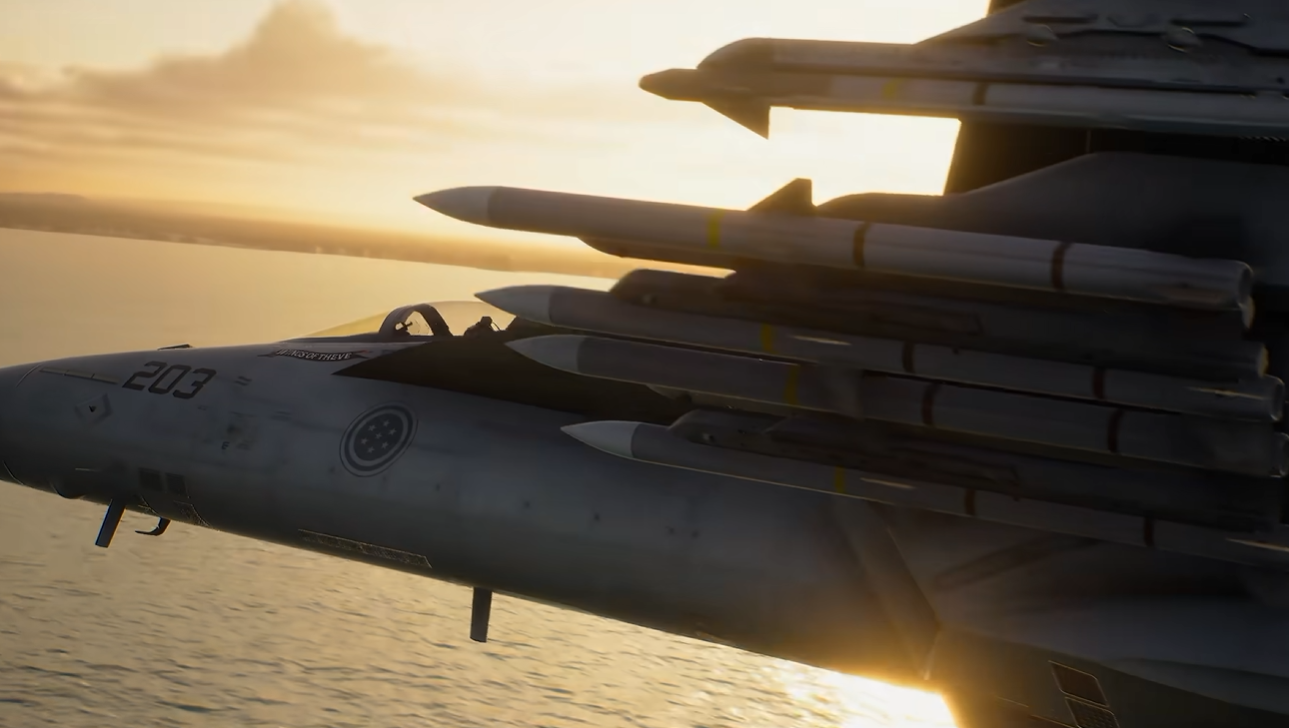
For a first campaign, I recommend prioritizing the multirole branch toward the F-35C instead of immediately trying to collect aircraft from every part of the tree.
The confirmed F-35C route starts with your F/A-18C Hornet, moves through the Mirage 2000-5, then lets you use either F/A-18E or F/A-18F Super Hornet before continuing through the EA-18G Growler and finally the F-35C Lightning II.
F-35C Aircraft Route
F/A-18C Hornet → Free
Mirage 2000-5 → 130,000 MRP
F/A-18E or F/A-18F Super Hornet → 240,000 MRP
EA-18G Growler → 350,000 MRP
F-35C Lightning II → 550,000 MRP
Aircraft cost after the starter Hornet: 1,270,000 MRP
You will spend more than that because parts sit between aircraft on the branch, but I like this route because the purchases remain useful instead of feeling like pure toll booths on the way to the final plane.
The Super Hornets are particularly valuable during the first campaign, the Growler has a second life as an excellent support aircraft for your squadron, and the F-35C gives you a high-end multirole that remains useful when missions mix air and surface targets.
The F-35C also leaves you well positioned for the post-game X-40, so the MRP you spend getting there continues to matter after Mission 30.
That does not make it the only good Aircraft Tree route. If you already know you want the F-22A, Su-57, Rafale M, or another favorite aircraft, building toward that destination is completely reasonable. The important part is having a destination instead of buying everything as soon as it appears.
How the Aircraft Tree Works
The Aircraft Tree is where you spend campaign MRP on aircraft, special weapons, and upgrade parts.
Aircraft become progressively more expensive as you move farther into the tree, but the plane itself is not always the full cost of reaching the next tier. Parts and other nodes between aircraft also consume MRP, which is why looking only at an individual plane's listed price can underestimate what it actually takes to reach it.
Your starting F/A-18C Hornet costs nothing, which gives you some freedom early on. You do not need to replace it immediately just because another aircraft becomes available.
Instead, think about Aircraft Tree purchases in three categories:
Every Purchase Should Do One of These
Improve what you can fly right now
Move you toward a specific late-game aircraft
Unlock a part, weapon, or squadron option you actually want
If a purchase does none of those things, it can probably wait.
Carrier Aircraft Matter More on Your First Playthrough
Ace Combat 8 makes carrier capability much more important than it initially looks.
Joker Flight spends a significant portion of the first campaign operating from the Endurance, and carrier-based missions restrict which aircraft you can actually take into the sortie. That makes a theoretically stronger land-based aircraft less useful if the mission will not let you launch it.
This is one of the main reasons the Super Hornet route works so well for a first campaign.
You begin with the carrier-capable F/A-18C and can later move into the F/A-18E or F/A-18F instead of investing all of your early MRP into aircraft that may be unavailable for important sorties.
First-Run Rule:
Do not judge an aircraft only by its stats. An aircraft you can repeatedly launch from the Endurance can be more useful during the campaign than a stronger plane sitting unavailable in your hangar.
This matters less once you're replaying missions and expanding the whole tree, but it should absolutely influence where your early MRP goes.
Should You Get the F/A-18E or F/A-18F?
Either Super Hornet works for reaching the next stage of the F-35C branch, so I would make this choice around the special weapons you actually want rather than obsessing over the similar stat lines.
I prefer the F/A-18E if I want to lean harder into air-to-air combat, while the F/A-18F is an attractive alternative if I want more surface-attack flexibility.
The important part for Aircraft Tree planning is that you do not need to buy both just to continue toward the Growler and F-35C.
That makes the second Super Hornet an optional collection purchase instead of something I would prioritize during a first run.
Three Good Ways to Build Your Aircraft Tree
There is no single Aircraft Tree route that every player needs to follow. The better question is what you actually want the tree to give you.
I would break the main approaches into three strategies.
1. First-Playthrough Route
Prioritize carrier-capable aircraft and strong multiroles.
Super Hornet → Growler → F-35C is the standout destination.
Best if you want one efficient campaign path without constantly changing branches.
2. Fighter Rush
Choose the side of the tree that ultimately takes you toward the F-22A or Su-57.
Best if air-to-air combat is your priority and you already know which endgame fighter you want.
Accept that carrier missions may still force you back into another aircraft during the first campaign.
3. Weapon-First Route
Choose aircraft based on special weapon combinations rather than only their performance stat.
Aircraft such as the Rafale M, Gripen E, and other strong mid-to-high-tier multiroles can be worth pursuing if their loadouts match how you fight.
Best if you already understand which weapons you use most.
The third strategy becomes more useful once you have played enough missions to know what you actually value. A stat increase on the Aircraft Tree does not necessarily improve your clear times as much as getting access to a special weapon that fits the mission.
For a broader comparison of individual aircraft instead of tree efficiency, see my Ace Combat 8 best planes guide.
Do Not Ignore Aircraft for Your Wingmen
The Aircraft Tree is not only about what Joker flies.
Once you own an aircraft, additional copies can be purchased for your squadron for much less than the first copy. That means a plane you do not personally want to fly can still be a useful Aircraft Tree investment.
Electronic-warfare aircraft are the best example.
The EA-6B Prowler and EA-18G Growler can be extremely useful in a support role, particularly when assigned to a wingman. Instead of treating every squadron slot as another source of raw missile damage, an EW aircraft can contribute support while you stay in your preferred fighter or multirole.
This changes how I value the Growler in particular.
If you're already moving through it on the way to the F-35C, it is not simply an expensive 350,000-MRP gate. It can remain useful as part of your squadron after you stop personally flying it.
Tree Value Is More Than Your Personal Aircraft
Your main plane → What Joker flies
Extra copies → Better aircraft for squad members
EW aircraft → Support option for wingmen
Parts → Can improve several aircraft without replacing them
That is one of the reasons I would not rank Aircraft Tree purchases purely by the stats of the plane itself.
Should You Buy Aircraft or Parts First?
Do not spend every MRP point rushing toward the next aircraft.
A good part installed on a plane you already like can sometimes improve your campaign more than replacing that aircraft with the next available model.
This is especially true for the early F/A-18 family because Ace Combat 8's aircraft generally feel heavier than some previous games. Better maneuverability can make normal turns significantly more comfortable and reduce how often you need to bleed speed with a High-G Turn.
For standard missiles, reload and guidance upgrades are also valuable because MSLs remain useful regardless of which special weapon you bring.
My priority is usually:
Early Part Priorities
General maneuverability
Pitch / aircraft response if the plane feels heavy
Standard missile reload
Standard missile guidance
Acceleration or speed if your current aircraft needs it
Do not buy every part just because it appears on the tree, either. Some parts are worth purchasing because they are on the route you already need, while others can be left for later completion.
My Ace Combat 8 best parts guide goes deeper into which BODY, ARMS, and MISC upgrades are actually worth using.
Do Not Try to Complete the Tree on Your First Campaign
The paid aircraft alone cost 8,900,000 MRP before accounting for the parts and special weapons scattered throughout the Aircraft Tree.
That should change how you approach the first playthrough.
Trying to fill every branch immediately spreads your currency across a huge number of aircraft when you only need a handful of good options to finish the campaign.
I would rather have one strong carrier aircraft, one high-end destination in mind, useful parts, and a good wingman setup than a hangar filled with early and mid-tier planes I never actually use.
You can clean up the rest of the tree later when you're replaying missions, hunting S ranks, collecting Assault Records, or working toward completion.
If you specifically need more currency, my Ace Combat 8 best MRP farming guide covers which missions are actually worth repeating depending on whether you care about pure MRP per minute or other unlocks at the same time.
All Ace Combat 8 Aircraft Tree MRP Costs
Rather than sorting the roster only by Fighter, Multirole, Attacker, and Electronic Warfare, I find it more useful to look at the Aircraft Tree by price tier. That immediately tells you how large of a purchase each plane represents.
Free
F/A-18C Hornet → Starting aircraft
A-6E Intruder → Clear Mission 14
25,000 MRP
F-4E Phantom II
MiG-21bis Fishbed
90,000 MRP
F-14D Super Tomcat
EA-6B Prowler
Su-25SM Frogfoot
130,000 MRP
F-2A
MiG-29A Fulcrum
MiG-31B Foxhound
Mirage 2000-5
180,000 MRP
A-10C Thunderbolt II
F-16C Fighting Falcon
Su-33 Flanker-D
Su-47 Berkut
240,000 MRP
F-15C Eagle
F-15J Eagle
F/A-18E Super Hornet
F/A-18F Super Hornet
Gripen E
Su-34 Fullback
350,000 MRP
EA-18G Growler
F-15E Strike Eagle
Rafale M
Su-35S Flanker-E
Typhoon
550,000 MRP
F-22A Raptor
F-35C Lightning II
Su-57 Felon
Post-Campaign
FA-36 Game → 750,000 MRP
EA-36 Barricader → 750,000 MRP
X-40 Nightmare → 1,000,000 MRP
This price-tier view is also useful when you're deciding whether another aircraft is actually worth delaying your next major purchase. Spending 180,000 MRP on a side aircraft feels very different when you realize you're already saving for a 550,000-MRP endgame jet plus the parts required to reach it.
How to Unlock the FA-36, EA-36, and X-40
The FA-36 Game, EA-36 Barricader, and X-40 Nightmare are post-campaign aircraft.
They appear after completing Mission 30, so there is no reason to hoard your entire first-playthrough MRP balance waiting for them to appear halfway through the story.
The FA-36 and EA-36 each cost 750,000 MRP, while the X-40 costs 1,000,000 MRP.
The X-40 also requires you to own one of the 550,000-MRP top-tier aircraft: the F-22A, F-35C, or Su-57.
This gives your first campaign's endgame purchase a second purpose. If you already know you want the X-40 after finishing the story, reaching one of those three aircraft before Mission 30 puts you in a much better position for the post-game.
Aircraft Outside the Normal Tree
Not every playable aircraft is a normal MRP purchase.
The F-14A Tomcat is bonus content rather than a standard Aircraft Tree unlock, while the ADFX-02 Morgan -PIXY- is connected to the Premium Ace Pass rather than the normal base-game MRP branches.
I would keep those separate when planning your Aircraft Tree because they do not change which normal branch you should spend MRP on.
If you have the Premium Ace Pass but have not claimed it yet, see my Ace Combat 8 Ace Pass redemption guide.
Aircraft Tree Mistakes I Would Avoid
The biggest mistake is buying every aircraft just because it becomes available.
The second is rushing toward a famous endgame fighter while ignoring the carrier restrictions and mixed mission objectives you still need to handle before you get there.
I would also avoid spending all of your MRP on planes while ignoring parts. A slightly weaker aircraft with the right maneuverability and missile upgrades can feel far better than a more expensive plane with an unfinished setup.
Finally, do not assume an electronic-warfare plane is wasted MRP because you do not personally want to fly it. Wingman use gives those purchases value beyond Joker's own loadout.
Simple First-Playthrough Plan
Keep using the F/A-18C while building MRP
Choose your eventual high-tier destination early
Prioritize carrier capability during the first campaign
Use the Super Hornet branch if aiming for the F-35C
Buy useful missile and maneuverability parts along the way
Consider an EW aircraft for a wingman
Leave unnecessary side branches for later
Finish Mission 30 before worrying about the FA-36, EA-36, or X-40
What Should You Unlock First?
If you have no favorite aircraft and simply want a strong first campaign, I would build toward a Super Hornet and eventually the F-35C while buying the useful parts you encounter on the way.
If you already know the F-22A, Su-57, Rafale M, or another aircraft is the reason you are playing, use the Aircraft Tree to work toward that instead. There is enough MRP in the long run to own everything.
The important part is not wasting your early currency trying to own everything at once.
Ace Combat 8's Aircraft Tree works best when every purchase has a purpose: improve your current setup, strengthen your squadron, or move you closer to the aircraft you actually want.