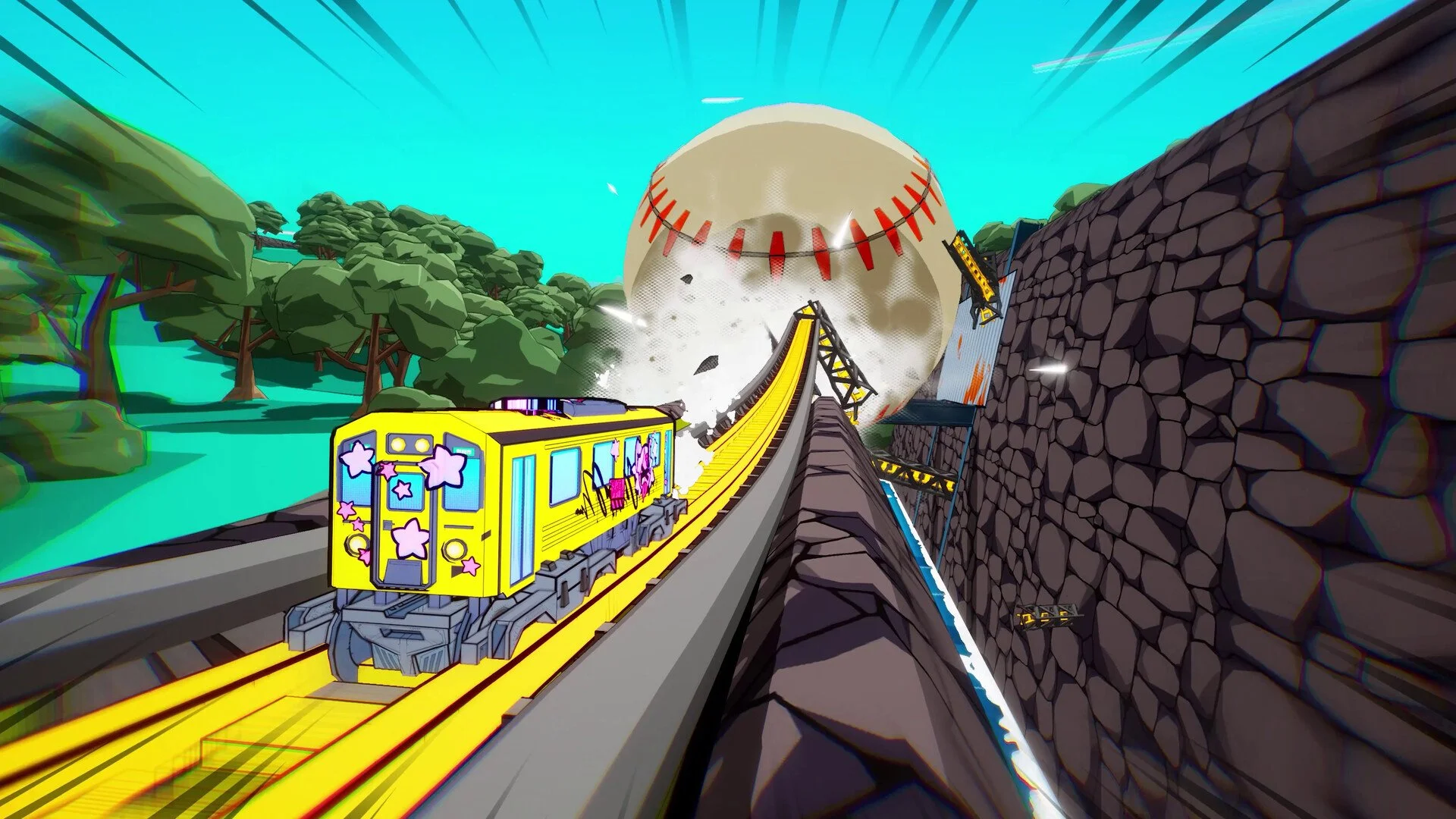
Denshattack may send you across Japan one railway at a time, but its campaign is considerably larger than the short arcade format initially suggests. The story regularly introduces new trains, mechanics, challenge formats, and increasingly ridiculous set pieces, while medals and alternate routes give completed stages a reason to remain on the map.
How Many Levels Are in Denshattack?
Denshattack has 67 stages across its complete campaign. These are distributed throughout nine campaign sections and include regular point-to-point routes, races, open exploration missions, Trick Parks, and boss encounters.
The 67-stage total counts the playable stages themselves. Individual medal objectives, alternate paths, secrets, and repeat attempts do not each count as additional levels.
| Content | Amount |
|---|---|
| Total playable stages | 67 |
| Main geographic regions | 8 |
| Campaign sections | 9 |
| Japanese prefectures represented | 46 |
| Approximate story length | 10 to 15 hours |
Most stages are relatively short when cleared successfully, but Denshattack frequently changes the objective and introduces new mechanics. The total feels larger than 67 straightforward races because the campaign rarely asks you to perform the exact same task for long.
Why Do Some Sources Say Denshattack Has Over 60 Levels?
Denshattack was commonly described before release as having more than 60 levels spread across eight regions. That description is accurate as a rounded overview, but it does not provide the final exact stage count.
The completed game contains 67 stages. The “60+” figure simply avoids stating the exact number, while the eight-region figure refers to the major geographic regions of mainland Japan represented on the world map.
The story itself continues through nine numbered campaign sections. This is why full-game reviews and walkthroughs may refer to nine regions or chapters even though broader descriptions mention eight Japanese regions.
| Number You May See | What It Means |
|---|---|
| 60+ levels | Rounded promotional description |
| 67 stages | Exact full-game stage count |
| 8 regions | Main geographic regions represented on the map |
| 9 chapters or sections | Complete campaign structure, including the final section |
The numbers are therefore describing slightly different parts of the game rather than separate versions with missing stages.
How Many Regions Does Denshattack Have?
Denshattack’s journey covers Japan’s eight main geographic regions and 46 prefectures. The campaign begins in Kyushu before moving through increasingly different parts of the country, with each major stop introducing its own visual identity, rival groups, hazards, and track designs.
The complete story is divided into nine numbered sections. The final section extends the campaign beyond the straightforward eight-region geographic breakdown, which creates the conflicting region counts found in some descriptions.
Stages within a region are not all built around the same format. One area may contain a standard route, a race, an open mission, and a large boss encounter before the story moves to the next section.
New mechanics are also introduced gradually. Later regions expect you to combine drifting, grinding, charged jumps, tricks, wall rides, route changes, and other abilities that were taught separately during the opening hours.
Every Denshattack Level Type Explained
The 67 levels are split between several formats rather than functioning as identical races to the finish line.
| Level Type | How It Works |
|---|---|
| Standard routes | Reach the end while maintaining speed, performing tricks, and avoiding crashes |
| Races | Compete against rival trains and finish in a required position |
| Exploration missions | Navigate a larger network of tracks and complete several objectives |
| Trick Parks | Use an open stunt area to build the highest possible score before time expires |
| Boss battles | Use learned movement and trick mechanics during large scripted encounters |
Standard stages are the closest Denshattack comes to a traditional on-rails platforming level. You move from the starting point to the goal, but the route may include jumps, grinds, track changes, walls, environmental hazards, and opportunities to extend a trick combination.
Races place more emphasis on maintaining momentum and choosing an efficient route. Crashing costs time, while a well-timed drift release or shortcut can create enough speed to overtake a rival near the finish.
Exploration stages open the track network and give you several jobs to complete. These missions reward learning the layout because objectives may sit on different branches that cannot all be reached by following the first available rail.
Trick Parks work more like skate parks than races. There is no distant finish line to chase; the objective is to understand the environment, locate strong combo routes, and use the available time efficiently.
Boss levels turn the game’s movement system into larger set pieces. They still rely on the same controls, but may involve attacking an enormous enemy, avoiding collapsing scenery, or reacting to mechanics used nowhere else in the campaign.
Are Denshattack Levels Linear?
Many standard stages follow a clear route from the beginning to the finish, but Denshattack is not completely linear. Some courses contain branching tracks, alternate routes, and secret exits that reward players who react quickly or return with a better understanding of the layout.
A faster route may require a difficult jump or track change, while a safer path gives you more room to maintain a combo. The best option can also change depending on whether you are chasing a Time medal, a Score medal, or a specific Dare objective.
Exploration stages are considerably more open. Instead of following one uninterrupted railway, you navigate interconnected tracks and mentally map the area while completing deliveries or other objectives.
Trick Parks are the least linear stages because they allow you to construct your own scoring route. Learning where rails, ramps, walls, and transferable lines connect is more important than moving toward a traditional endpoint.
How Long Does Denshattack Take to Beat?
The Denshattack campaign takes approximately 10 to 15 hours to complete. A straightforward playthrough focused on reaching the credits should fall near the lower end, while players who replay stages for better results during the story will move closer to the upper end.
One complete review playthrough took around 13 hours, which is a reasonable middle estimate for a first run. Individual stage length varies, but many can be completed in only a few minutes after you understand their routes and objectives.
Difficulty and retry frequency can move the total significantly. Later races, challenges, and bosses expect more precise control, and a stage that lasts several minutes can take considerably longer once failed attempts are included.
| Playstyle | Estimated Length |
|---|---|
| Story-focused playthrough | Around 10 hours |
| Typical first playthrough | Around 12 to 15 hours |
| Story with frequent medal attempts | 15 hours or more |
| Full completion | Considerably longer, depending on skill |
How Medals and Level Replayability Work
Finishing all 67 stages does not mean you have exhausted them. Levels can be revisited to improve results, test newly unlocked trains, follow alternate routes, and complete objectives that were missed during the initial clear.
The primary performance categories include Score, Time, and Dare medals.
| Medal | Requirement |
|---|---|
| Score | Earn enough points through tricks and combinations |
| Time | Reach the goal within the required completion time |
| Dare | Complete a stage-specific challenge or condition |
These goals often encourage completely different runs. The fastest path may contain fewer scoring opportunities, while the strongest trick route may be too slow for the best Time result.
Dare objectives can require specific actions, route choices, or performance conditions. Some happen naturally during an ordinary attempt, while others make more sense after you understand the stage and return with a suitable train.
New trains can also change how older levels feel. Improved attributes or a different handling profile may make a previously difficult medal much more manageable, so there is little reason to force every perfect result during the first visit.
Do You Need to Complete Every Medal to Beat Denshattack?
You do not need to perfect every stage before progressing through the campaign. The main story can be completed without earning every Score, Time, and Dare medal on the first attempt.
The more efficient approach is to clear the story route, unlock additional trains and mechanics, and then return to earlier levels. Later equipment and improved mechanical knowledge make many medal requirements easier than they were during the first visit.
Players pursuing full completion will need to revisit the entire stage list, search branching routes, discover secrets, improve medal results, and master the different challenge formats. The campaign may take around 10 to 15 hours, but completing everything can extend the game well beyond the credits.
The largest variable is player skill. A Time medal that requires ten retries for one player may take another player an entire evening, while Trick Park scoring can remain open-ended as you optimize routes and multipliers.
Denshattack’s Full Level Count Explained
Denshattack has 67 stages across nine campaign sections, with its world map representing eight major Japanese regions and 46 prefectures. The frequently quoted “60+ levels across eight regions” description is a rounded overview rather than a different stage count.
The total includes standard routes, races, exploration missions, Trick Parks, and boss battles. Some levels offer alternate tracks or secret exits, while every completed stage can be replayed for stronger Score, Time, and Dare results.
Expect approximately 10 to 15 hours to reach the credits. Completing every medal, finding hidden routes, and mastering all 67 stages will take considerably longer, particularly once the game stops teaching trains to kickflip and starts expecting them to do it under pressure.