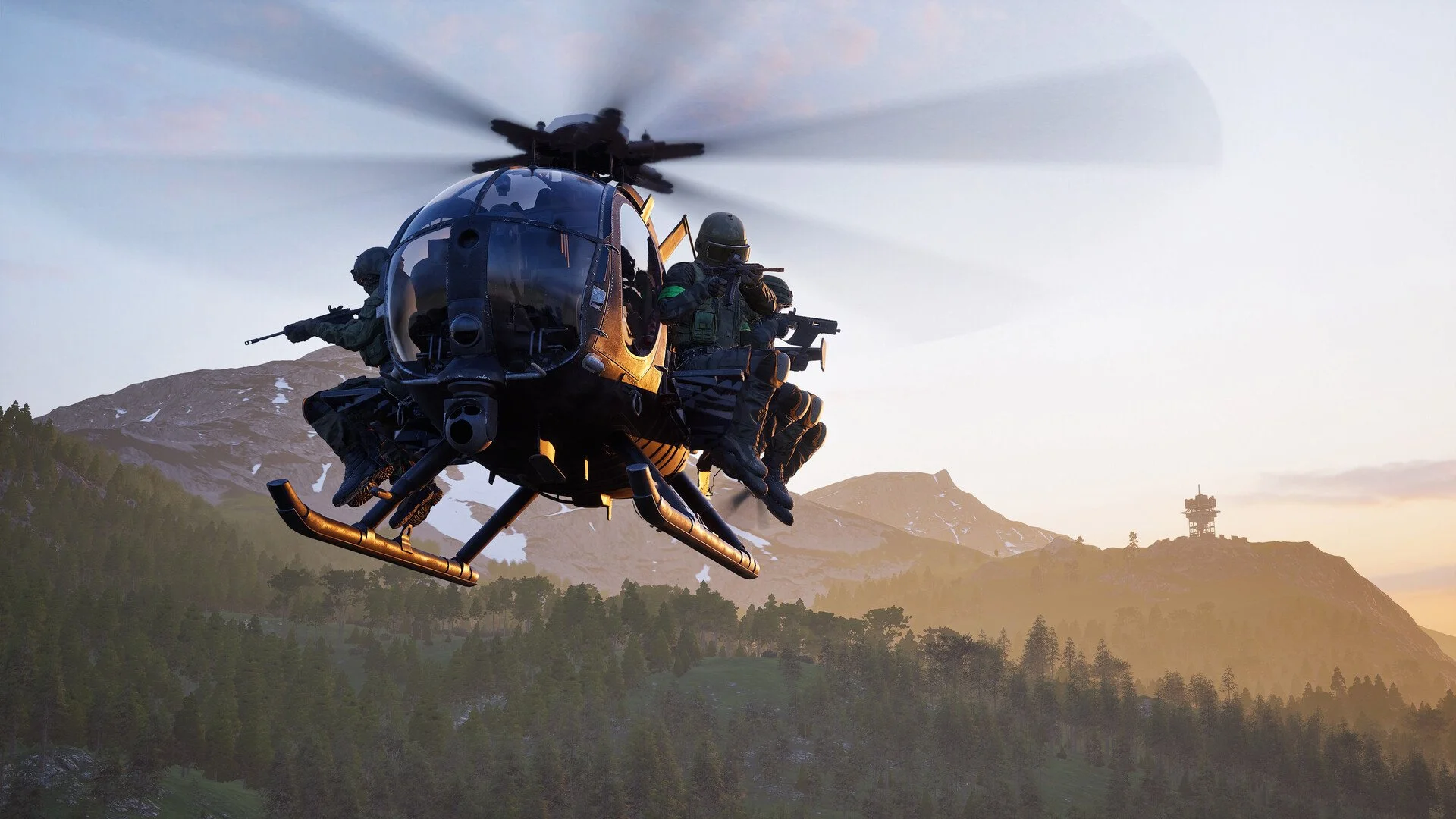
WARDOGS helicopter controls are unusual because there is no single setup that is obviously best for every pilot. Experienced players are flying extremely well with completely different layouts, and copying someone with thousands of hours of muscle memory can actually make learning harder. For a new pilot, I would build the controls around one idea instead: put the movements that require precision on an analog input like the mouse, then leave the larger maneuvering inputs on the keyboard.
Jump To Section:
Best Helicopter Controls
Best Mouse and Keyboard Setup
Attack vs Transport Controls
Best Flight Assist Settings
Best Helicopter Sensitivity
Controller vs Mouse and Keyboard
Is HOTAS Better?
How to Learn Your Controls
Use Mouse Pitch and Yaw With Keyboard Roll for the Best Starting Setup
For a new WARDOGS helicopter pilot on mouse and keyboard, I would start with mouse movement controlling Pitch and Yaw, A and D controlling Roll, and W and S controlling Collective. I would also enable Stability Assist while leaving the other flight assists off initially.
My recommended starting layout looks like this:
Mouse Up/Down: Pitch
Mouse Left/Right: Yaw
A/D: Roll Left/Right
W/S: Collective Increase/Decrease
Stability Assist: On
Other Flight Assists: Off initially
This is deliberately different from the common Battlefield-style layout that puts Pitch and Roll on the mouse while leaving Yaw on the keyboard. That setup absolutely works, and experienced pilots use it successfully, but I think Pitch plus Yaw on the mouse makes more sense as the starting point if you have no existing helicopter muscle memory.
The reason is aiming. Pitch and Yaw are the two movements that let you point the nose directly at something. Putting both on the mouse makes aiming the helicopter feel more like aiming normally in an FPS, while Roll remains available on the keyboard when you actually need to bank into harder maneuvers.
Separate Helicopter Aiming From Helicopter Maneuvering
The most useful way I have found to think about WARDOGS helicopter controls is not mouse versus keyboard. It is precision controls versus maneuver controls.
A keyboard input is effectively an on/off command. Press the key and you are giving the helicopter that input; release it and you are not. Mouse movement gives you much finer control over how much correction you actually want to make.
That difference matters near the ground, while lining up a landing, and especially when trying to put an attack helicopter's weapons onto a target.
This is why I prefer Pitch and Yaw on the mouse. If your nose is slightly too far left, you can make a tiny right correction instead of tapping a digital Yaw key and hoping the movement is small enough. The same logic applies when raising or lowering the nose onto a distant target.
Roll is different. I primarily care about it when banking, changing direction aggressively, or setting up a larger maneuver, so I am much more comfortable leaving it on A and D.
Collective then fits naturally on W and S. You can increase or decrease lift while your mouse hand remains dedicated to controlling where the helicopter is pointing.
Attack and Transport Helicopters Benefit From Different Priorities
This is where I would push back on the idea of one universal “best” helicopter layout.
If you primarily fly transport helicopters, the classic Pitch and Roll on mouse setup is perfectly reasonable. Transport flying is more about controlling your movement, setting up approaches, dropping passengers, and getting back out safely. A Battlefield-style layout with Mouse Pitch and Roll, W/S Collective, and A/D Yaw can feel very natural if that is what you already know.
For an attack helicopter, I would favor Pitch and Yaw on the mouse much more strongly. When your job includes putting miniguns or rockets onto a target, directly controlling the nose in both axes with the mouse gives those movements the most precise input you have available.
That creates a useful rule: if your helicopter itself is the weapon, prioritize mouse aiming. If you are primarily transporting people, prioritize whichever flight layout gives you the most confident maneuvering and landings.
I would not force an experienced Battlefield, Arma, or Squad pilot to relearn years of muscle memory just because another layout is theoretically cleaner. This recommendation is aimed at someone starting from scratch.
Start With Stability Assist On and the Other Assists Off
For a new WARDOGS pilot, Stability Assist is the one assist I would keep enabled initially.
Community pilots have found a good middle ground using Stability Assist while disabling the other assists, which gives you some help keeping the aircraft manageable without having every part of your flying mediated by an assistance system.
I prefer this over turning everything on because you still need to learn what Pitch, Roll, Yaw, and Collective actually do. Too much automated correction can make it harder to understand why the helicopter is responding a particular way, especially once you start attempting sharper maneuvers.
It also gives you somewhere to progress. Learn takeoffs, basic forward flight, turns, approaches, and landings with Stability Assist helping you. Once the helicopter consistently feels predictable, you can test flying without it and decide whether the extra freedom is worth the additional workload.
I would not turn assists off on day one simply because an experienced pilot does it. Their control setup may be designed around thousands of hours of muscle memory that you do not have yet.
Use Lower Mouse Sensitivity Before Trying to Make the Helicopter Faster
I would start WARDOGS helicopter mouse sensitivity on the lower side rather than immediately pushing it upward.
The goal is not to make every movement as fast as possible. You need to be able to make a small Pitch or Yaw correction without repeatedly overshooting the angle you wanted. That becomes particularly important while approaching a landing zone or aiming an attack helicopter.
There is no single sensitivity number I would claim is objectively best because mouse DPI changes the result anyway. Instead, tune it around your ability to make fine corrections. If you can easily keep the nose on a point while moving and still make a larger turn without constantly running out of mousepad, you are in a useful range.
If aiming feels twitchy, lower sensitivity. If precise corrections feel good but rotating the aircraft requires ridiculous amounts of mouse movement, raise it gradually.
I would not use Yaw sensitivity alone as a solution for every turning problem either. Players have reported maxing Yaw sensitivity and still struggling with sharp combined Roll and Yaw turns. At that point, the limitation is not necessarily that your sensitivity number is too low; your choice of input and how you combine the helicopter's axes also matter.
Do Not Treat Yaw Like a Minor Helicopter Control
Yaw is easy to underestimate when you first start because Roll produces the much more obvious banking movement. Once you begin landing in tight areas or trying to aim the aircraft, Yaw becomes one of your most important inputs.
Pitch controls the nose vertically, Roll banks the helicopter, Collective manages lift, and Yaw rotates the helicopter around its vertical axis. During low-speed flight, that lets you change where the aircraft is facing without needing to make a huge banking turn.
That is exactly why I do not love leaving Yaw exclusively on Q and E for a brand-new pilot. It takes one of the inputs you use to point the nose and turns it into a binary keyboard command.
If you prefer the traditional mouse Pitch/Roll arrangement, that is fine. I would just understand the trade: your mouse becomes excellent for maneuvering the aircraft, while fine horizontal nose adjustments are now being handled elsewhere.
Mouse and Keyboard Is My Pick Over Controller for Helicopters Right Now
If I had to choose between normal mouse and keyboard and a stock controller specifically for WARDOGS helicopters, I would currently choose mouse and keyboard.
A controller theoretically makes a lot of sense for flying because analog sticks can provide progressive input rather than the keyboard's on/off movement. The problem is that WARDOGS' controller support and native remapping have been limited during the Beta and Early Access period, and players have specifically complained about helicopter Yaw being placed on buttons rather than having the axis arrangement they want.
Steam Input can be used to build more customized controller behavior, including mapping a stick as mouse input, but I would consider that an advanced workaround rather than the setup every new pilot should immediately use.
If you are already committed to gamepad, our WARDOGS best controller settings guide covers sensitivity, deadzones, response curves, and the current limitations of the game's controller implementation.
The situation could change substantially as controller support improves. Analog Pitch, Roll, and Yaw with fully customizable bindings could make controller a much stronger helicopter option than the current default layout suggests.
HOTAS Gives You Better Analog Control, but You Do Not Need One
A proper flight stick or HOTAS setup has a genuine advantage in WARDOGS because the helicopter's major movements map naturally onto analog axes.
A flight stick can handle Pitch and Roll, a throttle can provide progressive Collective control, and either a twist axis or rudder pedals can handle Yaw. Instead of tapping keys, you can vary each input much more precisely.
That is particularly useful when several inputs need to happen together. A landing approach can require small changes to direction, altitude, and orientation at the same time, which is exactly where analog controls make sense.
I still would not buy a full flight setup just because you want to try WARDOGS helicopters. Experienced players are successfully flying on mouse and keyboard, and there is no reason to assume you cannot become a good pilot without dedicated hardware.
If helicopters become the main reason you play, then a stick starts making much more sense. You also do not necessarily need the most elaborate HOTAS and pedal setup available; the important advantage is getting the major flight controls onto useful analog axes.
Check for Keybind Conflicts Before Building Muscle Memory
One WARDOGS-specific problem I would check immediately is whether your chosen helicopter binds conflict with another vehicle function.
Players have reported situations where otherwise sensible helicopter bindings interfered with weapon controls, including using Space for Collective Up while flying the minigun helicopter. There have also been complaints about bindings from different control modes conflicting when players try to customize aircraft controls.
That means I would test more than takeoff and landing before committing to a layout.
Get into an attack helicopter, check every weapon, verify Collective in both directions, make sure Pitch, Roll, and Yaw all work simultaneously, and only then start building muscle memory around the setup.
A control scheme that feels fantastic during an empty transport flight is not actually a good WARDOGS control scheme if one of its keys stops you from using an important weapon later.
Learn Four Movements Before You Learn Helicopter Tricks
I would not start by trying to copy sharp J-hooks, instant reversals, or the aggressive landings you see experienced WARDOGS pilots pulling off.
First, get comfortable with four things independently: Pitch changes your forward and backward attitude, Roll banks you left and right, Collective controls your climb and descent, and Yaw changes where the nose is facing.
Then combine them. Practice taking off, moving forward, making a controlled turn, slowing down, lining the helicopter up with a landing point, descending, and leaving again.
The landing part is especially important because the best landing is not necessarily the prettiest one. If you are flying transport, getting passengers close to an objective while retaining an escape route can be considerably more valuable than forcing the helicopter directly into the middle of the fight.
I would actually judge a new control layout by landings before flashy maneuvers. If you can repeatedly approach a small area, make precise corrections, put the helicopter down where intended, and leave without fighting your inputs, the controls are doing their job.
Build Your WARDOGS Helicopter Controls Around Your Job
The biggest mistake with WARDOGS helicopter settings is assuming the player with the craziest flying must also have the objectively best controls. Community pilots with thousands of hours across flight games are using wildly different setups and still reaching the same result because muscle memory eventually becomes more important than the exact keys.
For someone without that muscle memory, I would start with Mouse Pitch and Yaw, A/D Roll, W/S Collective, Stability Assist On, and the other assists Off. It gives the mouse the two axes I care about most for precise nose control while the keyboard handles the larger maneuvering inputs.
If you mainly fly transport and already understand Battlefield-style controls, Mouse Pitch/Roll with keyboard Yaw is a completely reasonable alternative. If you primarily use an attack helicopter, I prefer moving Yaw onto the mouse because aiming the aircraft itself becomes much more important.
Most importantly, choose a sensible layout and stop changing it every three matches. A slightly imperfect setup that you understand instinctively will eventually be more useful than constantly jumping between five different YouTube pilots' “perfect” settings and never developing muscle memory with any of them.
And if inconsistent performance is making aircraft controls feel worse than they should, our WARDOGS best graphics settings for FPS covers the settings I would lower first without unnecessarily sacrificing battlefield visibility.