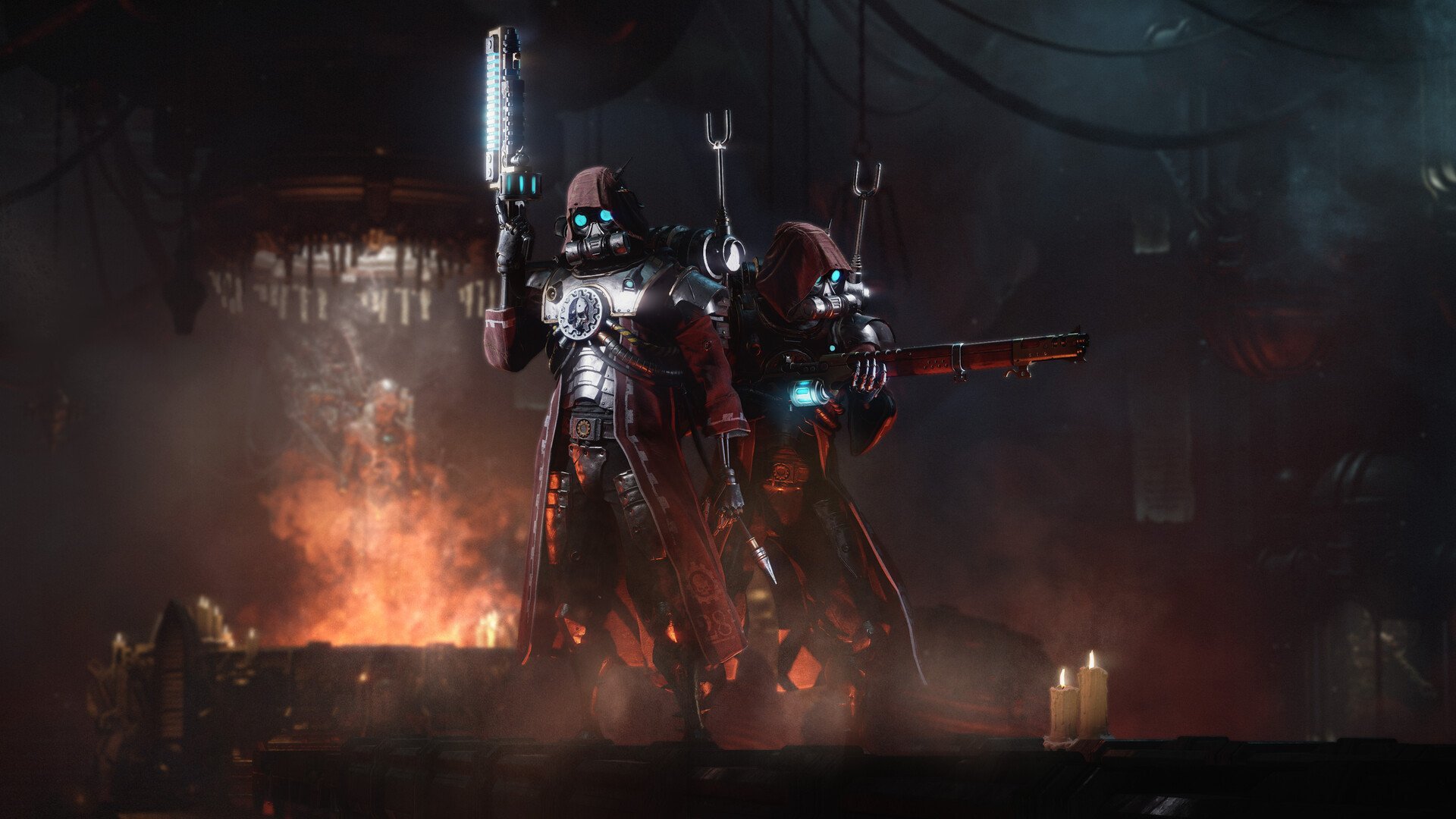
The Skitarii Alpha Primus in Warhammer 40,000: Darktide is an Adeptus Mechanicus class built around precision shooting, Arc damage, Servo Skull utility, melee execution, and a flexible cog-style talent tree. The best way to approach Skitarii early is to pick one clear job first: ranged weakspot killer, Arc crowd-control hybrid, Servo Skull support, or aggressive melee Tech-Priest nightmare with Transonic Blades.
Skitarii looks like the kind of class that can do too much on paper, which is exactly why the first mistake will be spreading points everywhere. The class has weapons, Servo Skull tools, Capacitance-based abilities, Arc effects, support talents, melee paths, ranged paths, and team auras. That is exciting, but it also means a messy Skitarii build can become a half-finished robot doing four jobs badly.
Jump To
How Skitarii Plays
Skitarii plays like a flexible specialist class, not a simple Veteran reskin.
The class has a strong ranged identity because of Galvanic Rifles, Arc Rifles, Phosphor weapons, lock-on style accuracy tools, and ranged talents. It also has real melee support through Transonic Blades, Arc Maul, Mechanicus Power Sword, Chordclaw Strike, and melee talents that reward close-range pressure.
The part that makes Skitarii different is the support machinery layered on top. The Servo Skull can shoot enemies, handle Data Interrogations, and branch into more specialized skulls with talents. The class also has a Capacitance system, which means some abilities are not just normal cooldown buttons. They grow stronger or become more flexible based on charge management.
My read is that Skitarii should not be built as “a little bit of everything” unless the player already knows the class well. Pick a primary role, then use the extra tools to cover weaknesses. A ranged Skitarii can still bring team utility. A melee Skitarii can still use Arc effects. A Servo Skull build can still kill things. The trick is deciding what the build is supposed to be good at before the talent tree starts looking like a sacred plate of spaghetti.
Best Skitarii Build Directions
The best Skitarii build direction depends on whether the goal is precision damage, Arc control, melee aggression, or team utility.
| Build Direction | Main Idea | Best Fit |
|---|---|---|
| Galvanic Rifle Marksman | Weakspot shooting, elite removal, high accuracy | Players who like Veteran-style target priority |
| Arc Control Hybrid | Electrocution, stagger, crowd control, chained damage | Players who want horde control without giving up ranged pressure |
| Transonic Melee | Fast melee kills, close-range aggression, elite dueling | Players who want a more violent Skitarii setup |
| Servo Skull Support | Objective help, Medicae utility, team safety | Players who like support without becoming passive |
The Galvanic Rifle route is probably the cleanest starting point because Darktide always rewards players who remove shooters, gunners, specials, and elites quickly. Skitarii’s fantasy fits that role well: aim cleanly, delete priority targets, and let the rest of the squad breathe.
The Arc Control Hybrid is the more interesting path. Arc effects can jump between affected enemies, and Skitarii talents can lean into Electrocution, Brittleness, stagger, and damage against statused targets. This is the build direction I would watch closely because it may end up being the most “Skitarii” version of the class instead of just another good shooter.
Transonic melee sounds fun, but it will probably punish bad positioning harder. Darktide melee builds need toughness management, dodge discipline, and a plan for ranged pressure. Skitarii can support that playstyle, but the player still has to survive while doing robot blender work in the middle of a crowd.
Servo Skull support is the sleeper option. Darktide objectives can get messy fast, and a class that can send a skull to handle Data Interrogation while still fighting has real value. That will not always show up on the scoreboard, but the team will feel it when an objective section does not collapse into four people screaming around a console.
Capacitance and Combat Abilities
Capacitance is Skitarii’s ability charge system, and it is one of the main reasons the class should feel different from Darktide’s existing roster.
Instead of thinking only in cooldowns, Skitarii players need to think about charge generation and charge spending. Fatshark has described Capacitance as something generated through combat actions, including killing basic enemies and elites, with talents that can change how more charge is earned.
The three major combat ability styles are:
- Voltaic Emitter, an electric discharge around the player that can stun, electrify, and damage nearby enemies.
- Chordclaw Strike, a heavy melee attack that can be used in succession because it does not consume multiple Capacitance Charges.
- Advanced Combat Doctrines, a short-duration accuracy tool that locks onto enemies near the reticle.
Voltaic Emitter sounds best for players who want control. It gives the class a panic button, a horde stabilizer, and a way to spread the Arc identity into close-range fights.
Chordclaw Strike is the aggressive option. A Skitarii who wants to stay active in melee should pay attention to this because repeatable heavy strikes can turn stored charge into real tempo instead of sitting on an ability for the “perfect” moment that never arrives.
Advanced Combat Doctrines is the cleanest ranged identity button. In a game where missing a key special can get someone netted, grabbed, flamed, or deleted by shooters, temporary inhuman accuracy is more than style. It is a priority-target answer.
Servo Skull Guide
The Servo Skull is the default Skitarii Blitz and companion, and it is one of the class’s biggest identity pieces.
The basic Servo Skull can shoot enemies and can be commanded to complete Data Interrogations. That matters because objective pressure is one of Darktide’s most reliable ways to break random teams. A player stuck on a console is not dodging, clearing, reviving, or controlling a flank. A Servo Skull that can take over part of that job gives the squad more room to survive.
The tradeoff is speed. The skull may be slower than a strong player doing the objective manually, but the value is that the Skitarii can keep fighting while the skull works. That is the kind of support I like because it does not ask the player to stop playing the game.
Talent investment can unlock specialized Servo Skulls, including Flamethrower and Medicae versions. The Flamethrower skull leans into extra firepower and horde pressure. The Medicae skull is the team-safety option and can help with allies who are downed, netted, or otherwise disabled.
The main choice is whether the build wants the Servo Skull as a utility tool or a central identity. A ranged assassin Skitarii may only need the basic objective help. A support Skitarii may want to spend deeper and become the team’s weird little machine-priest problem solver.
Best Skitarii Weapons To Try First
The best Skitarii weapons to try first are the Galvanic Rifle, Arc Rifle, Arc Maul, and Paired Transonic Blades because they show the class’s unique identity immediately.
Skitarii’s unique weapon list includes:
- Galvanic Rifle
- Arc Rifle
- Phosphor Blast Pistol
- Mechanicus Power Sword
- Paired Transonic Blades
- Arc Maul
Galvanic Rifle should be the first serious ranged test. It fits the long-range assassin fantasy and gives Skitarii a clear job: remove important targets before they ruin the run. A good Galvanic build should care about accuracy, weakspots, reload rhythm, ammo economy, and target priority.
Arc Rifle is the weapon I would test for horde and mixed-pack control. Arc effects can be excellent when enemies are grouped or already affected by the Arc condition. That makes the weapon more interesting than a simple damage stick. The question is not only “does it hit hard?” The question is whether it turns ugly packs into manageable packs.
Arc Maul is the natural melee partner for an Electrocution build. It should fit players who want to be in the fight while still using the class’s electrical identity. This is where talents like Electrocution synergy, stagger support, and damage against statused enemies may matter.
Paired Transonic Blades are the flashier melee pick. They sound like the weapon for players who want fast kills, movement, and close-range execution. The downside is that fast melee weapons usually demand better positioning. They feel amazing when ahead and fragile when surrounded by shooters with no plan.
Mechanicus Power Sword is the safe “try this eventually” weapon. Power swords tend to be reliable in Darktide because they solve mixed-threat melee problems well. It may not be the most exotic Skitarii weapon, but reliability is not a crime.
Phosphor Blast Pistol is the sidearm to watch. Pistols can feel incredible when they give quick response time without locking the player into a slow ranged weapon. The real value will depend on breakpoints, ammo use, and whether it supports a melee or hybrid build cleanly.
How To Read The Talent Tree
Skitarii’s talent tree is different because it uses a cog-style structure instead of the normal top-down layout.
That design matters. A top-down tree usually pushes players through a predictable path. A cog tree asks for a more deliberate build plan. Start in the middle, branch toward the role that matters, and avoid grabbing every cool side node just because it is nearby.
The main talent categories to understand are:
- Melee talents for attack speed, melee crit effects, and close-range benefits.
- Ranged talents for reload, ammo sustain, delayed-shot bonuses, and shooting consistency.
- Support talents for revive safety, toughness sharing, and ally protection.
- Electrocution talents for Arc mechanics, Brittleness, stagger, and status damage windows.
The clean way to build Skitarii is to pick a core triangle. For example, a ranged build might focus on ranged talents, Advanced Combat Doctrines, and Ammunition Deposit. An Arc hybrid might focus on Electrocution talents, Voltaic Emitter, and an Arc weapon. A support skull setup might build around Servo Skull upgrades, Resurgence, and team protection tools.
The wrong way is to chase every mechanic at once. A few flexible points are fine. A whole build made of “this also looks neat” usually ends up with no damage, no defense, and a Servo Skull judging silently from shoulder height.
Best Team Role For Skitarii
Skitarii’s best team role is flexible specialist: kill priority targets, control dangerous packs, and use Servo Skull tools to keep objectives from falling apart.
That does not mean every Skitarii should be support. It means the class has ways to affect the fight beyond raw damage. A good Skitarii should know when to shoot, when to stabilize with Arc tools, when to send the skull, and when to protect a teammate during a bad revive or objective push.
The three Coherency Auras also shape the team role:
- Resurgence helps toughness regeneration in coherency.
- Ammunition Deposit gives allies more ammo reserve.
- Foe-Render Creed adds cleave and rending.
Ammunition Deposit fits ranged-heavy groups. Resurgence fits rougher public games where players take pressure often. Foe-Render Creed fits teams that want more melee and armor pressure.
For random matchmaking, I would lean toward the tools that keep bad situations from becoming failed missions. That usually means toughness help, objective utility, and reliable special killing. Damage is great, but Darktide wipes often come from one missed disabler, one failed objective, or one revive attempt that turns into a funeral line.
Common Skitarii Mistakes
The biggest Skitarii mistake is building around the fantasy instead of the job.
Adeptus Mechanicus flavor is strong enough that players are going to want every toy at once. Arc weapons, servo skulls, precision rifles, transonic melee, flamethrower skulls, lock-on doctrines, electric blasts, weird support tools. It all sounds good. It will not all fit cleanly into one build.
The common mistakes will probably be:
- Spreading talent points across too many roles.
- Using Servo Skull commands too late or forgetting them during fights.
- Taking melee talents without enough toughness or escape planning.
- Building Arc synergy without actually applying Electrocution often enough.
- Choosing a ranged aura but playing like a front-line duelist.
- Holding Capacitance abilities too long instead of spending them to control the fight.
Capacitance hoarding is the mistake I would watch for first. Charge systems can make players too greedy. A stored charge that saves the run is good. A stored charge that never gets used because the player is waiting for a perfect horde screenshot is wasted power.
The other mistake is ignoring the team. Skitarii has enough selfish damage options to play like a pure killer, but the class also has tools that can make the whole mission cleaner. The best version probably does both: kill the right targets and quietly remove some of the friction that normally gets teams killed.
Is Skitarii Worth Playing?
Skitarii is worth playing for Darktide players who want a class with more build structure, more utility decisions, and a stronger Adeptus Mechanicus identity than the existing roster.
The class looks strongest for players who enjoy making decisions during combat. It is not just “press ult, swing weapon, repeat.” The Servo Skull, Capacitance abilities, Arc status, ranged precision, and cog-style talent tree all reward players who like tinkering.
I would not recommend starting with a complicated hybrid immediately. The smarter first build is a clear ranged or Arc setup, then branch out once the class rhythm feels natural. Learn how Capacitance builds. Learn when the Servo Skull actually helps. Learn which weapons solve which problem. Then start making the weirder Omnissiah-approved abominations.
Skitarii should be one of the more interesting Darktide classes because it brings a different kind of power fantasy. It is not only stronger guns or sharper blades. It is a class about systems: charges, skulls, precision, status effects, and mechanical support layered over normal Darktide fundamentals.
The class will live or die on whether players respect that. A focused Skitarii should feel like a surgical machine built for heresy removal. A scattered one will feel like someone installed six sacred upgrades and forgot to read the manual.