Dressmaker Tips and Tricks Guide
Dressmaker gets much easier once you stop treating every commission as one giant sewing test. A good dress is really built in stages: understand what the customer actually wants, make design and fabric choices that fit that brief, use your material efficiently, and only then worry about executing the cut and stitches cleanly. Most expensive mistakes happen because one of those decisions gets rushed, so the best beginner strategy is to solve each part of the order before moving to the next instead of trying to improvise all the way to delivery.
Jump To Section:
Build Around the Customer Brief
Experiment Before You Commit Materials
Stop Wasting Fabric on Pattern Layouts
Check Grain Direction Before Cutting
Sew for Accuracy, Not Speed
Don't Spend the Entire Budget on Fabric
Let Progression Expand Your Options
Diagnose Bad Scores Correctly
Design for the Customer Before You Design for Yourself
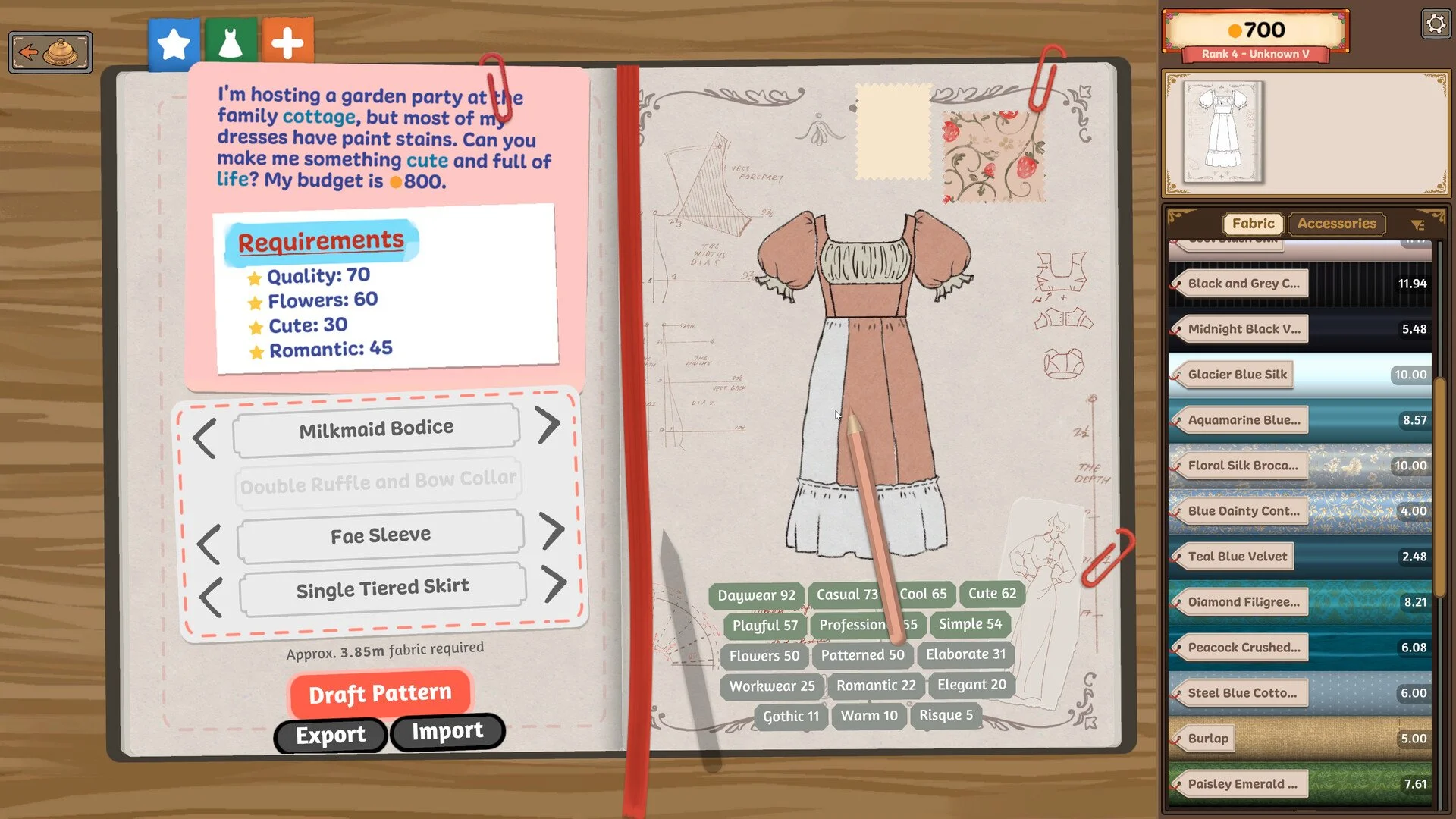
The fastest way to make a beautiful dress that still disappoints the customer is to forget why they're buying it. Dressmaker gives you room to experiment, but each commission starts with an occasion, preferred style, and budget that should narrow your choices before you start worrying about what personally looks best.
If a customer wants something professional and modest, for example, don't start by making the most dramatic garment you can and then try to force the request around it. Use the brief as your filter. Once the important requirements are covered, that's when you can start making the dress yours.
I think this is one of the better ways to approach the entire game: treat every commission as a constrained design problem rather than a recipe. The customer gives you boundaries, not necessarily a finished outfit to copy.
That also means the style information in the sketchbook is more useful than it first appears. If the pieces you're considering are pushing the design toward the wrong type of dress, catch that while you're still planning rather than after you've bought fabric and sewn the thing together.
Experiment While Your Decisions Are Still Cheap to Change
Not every mistake costs the same amount in Dressmaker. Changing your mind while you're still choosing a design is relatively painless. Discovering that you hate the result after buying fabric, cutting every panel, and sewing half the garment is not.
Use that to your advantage. Try different fabric combinations, swap dress components, and preview materials before committing to the production stage. The full game gives you enough creative freedom that experimenting is part of the point, but experimentation is much safer before your idea starts consuming resources.
A good workflow is to make the early part messy and the later part deliberate. Try the strange color combination in the sketchbook. See whether a different fabric works. Change the silhouette. Once you're confident in the concept, then become conservative with your actual material.
This is also why I wouldn't rush into buying the most expensive-looking fabric every time. Expensive doesn't automatically mean appropriate, and it definitely doesn't mean efficient.
Treat Pattern Placement Like a Puzzle Before You Make the First Cut
Pattern placement is one of the few places where a little patience can directly save you resources. Before cutting anything, look at the entire group of pieces and figure out how they're going to share the available fabric.
Don't place the first large piece in the most convenient position and assume the rest will work around it. Large or awkward shapes can create unusable gaps that leave plenty of fabric on paper but not enough continuous space for the piece you still need.
I would start with the pieces that are hardest to fit, then use smaller sections to fill the remaining spaces. It's basically inventory Tetris with fabric.
The other advantage is long-term rather than immediate. Leftover material can remain useful for future orders, so shaving a little waste from several dresses eventually gives you a much more flexible stash than constantly buying fresh fabric because every previous project left unusable scraps.
Never Cut a Pattern Piece Until Its Alignment Looks Right
One of the nastier Dressmaker mistakes is producing a garment that looks like you sewed it well but still ends up with disappointing quality because the problem happened earlier during cutting.
In the prototype documentation, pattern pieces include a grain-direction indicator and correctly aligned pieces are confirmed visually before cutting. Incorrect alignment can limit the quality you can achieve later, which means perfect sewing can't necessarily rescue a badly prepared piece.
So don't treat cutting as the mindless step between designing and sewing. Before committing each piece, check its orientation and whatever alignment feedback the current version gives you.
That's an important troubleshooting distinction: if you keep sewing carefully and still can't produce the quality you're expecting, don't automatically assume your sewing technique is the problem. Go backward through the workflow and check how the pieces were prepared.
Slower Sewing Is Usually Faster Than Restarting
Sewing is where trying to save five seconds can cost considerably more time. Dressmaker rewards staying close to the intended seam, and quality can fall quickly once you start wandering away from it.
I wouldn't try to maintain one constant speed through an entire piece. Straight sections are where you can be more confident. Curves, corners, cuffs, and short sections are where you should immediately slow down.
More importantly, stop thinking of pausing as failure. If your angle is starting to drift, stopping or easing off and correcting the fabric is better than stubbornly continuing because you're already moving.
The easiest way to improve is to look slightly ahead of where you're currently sewing. You're not reacting to the mistake after the fabric has already moved; you're setting up the next turn before you reach it.
If the current release still gives you a speed-control option, use it while learning. Getting a clean seam slowly teaches you more than repeatedly blowing through corners at full speed.
Keep Some of the Customer's Budget in Reserve
A customer budget isn't permission to spend every coin before you reach the finishing stage. Fabric is only one part of the garment, and expensive material can leave you with very little room when you later decide the dress needs trim, buttons, bows, or another finishing element.
I would think of the budget in layers. First make sure you can afford the actual garment. Then protect enough room for whatever details the commission is likely to need. Anything remaining after that is where you can indulge.
This becomes more important as your options expand. Early on, you may not have enough attractive choices to overspend creatively. Later, having more fabrics and decorative options makes it much easier to turn an otherwise simple order into an unnecessarily expensive one.
Leftover fabric is the other side of that equation. Before buying another bolt, check whether something you've already purchased can satisfy the new brief. Reusing material effectively means more of the customer's budget can go toward the parts that actually make this dress different.
Don't Judge the Entire Game by Your First Few Dress Options
Dressmaker gradually expands what you can work with. New fabrics, patterns, tools, and design possibilities appear as you continue completing commissions, while later customers ask for more complicated work.
That means the early game is a good time to learn the production loop rather than obsess over making your permanent dream wardrobe immediately. Your options are supposed to widen.
The progression also changes how you should think about experimentation. A combination that feels impossible now may simply need a fabric, pattern, or component you haven't unlocked yet. You don't need to force every idea through the limited early catalog.
At the same time, don't rush through customers just to unlock more stuff. Their stories continue across repeat visits, and progressing those relationships is part of what gives later commissions context rather than making the game a sequence of disconnected dress orders.
When a Dress Scores Poorly, Find the Stage That Actually Failed
This is probably the biggest practical tip I'd use throughout Dressmaker: don't respond to every bad result by simply “trying harder” on the next dress. Figure out which part of the process actually went wrong.
If the design feels wrong: Recheck the client's requested style and occasion.
If you're constantly running out of money: Simplify the pattern, reuse fabric, or leave more budget for finishing.
If material disappears too quickly: Improve the way pattern pieces are packed before cutting.
If sewing quality falls: Slow down before curves and correct your angle instead of powering through.
If careful sewing still doesn't produce the expected quality: Check whether an earlier cutting or alignment mistake is limiting the result.
The exact weighting behind Dressmaker's final evaluation isn't publicly documented, so I wouldn't waste time trying to reverse-engineer an imaginary formula. What's useful is knowing the broad things the game evaluates: the quality of the work, whether the design fits what the customer requested, and how you handled the available budget.
That turns a disappointing order into information. A technically perfect dress can still misunderstand the brief. A gorgeous concept can still waste too much material. A smart design can still be let down by sloppy construction. Once you know which category failed, the next commission gives you something specific to improve.
That's also why I'd resist trying to make every early dress perfect. Dressmaker gradually asks more from you, and there is enough room to experiment that some imperfect work is part of learning the systems. Get the brief right, make your expensive decisions before cutting, protect the fabric you already own, and slow down when precision actually matters. Once those habits become automatic, the more complicated commissions become much less intimidating.