Over the Hill Best Car
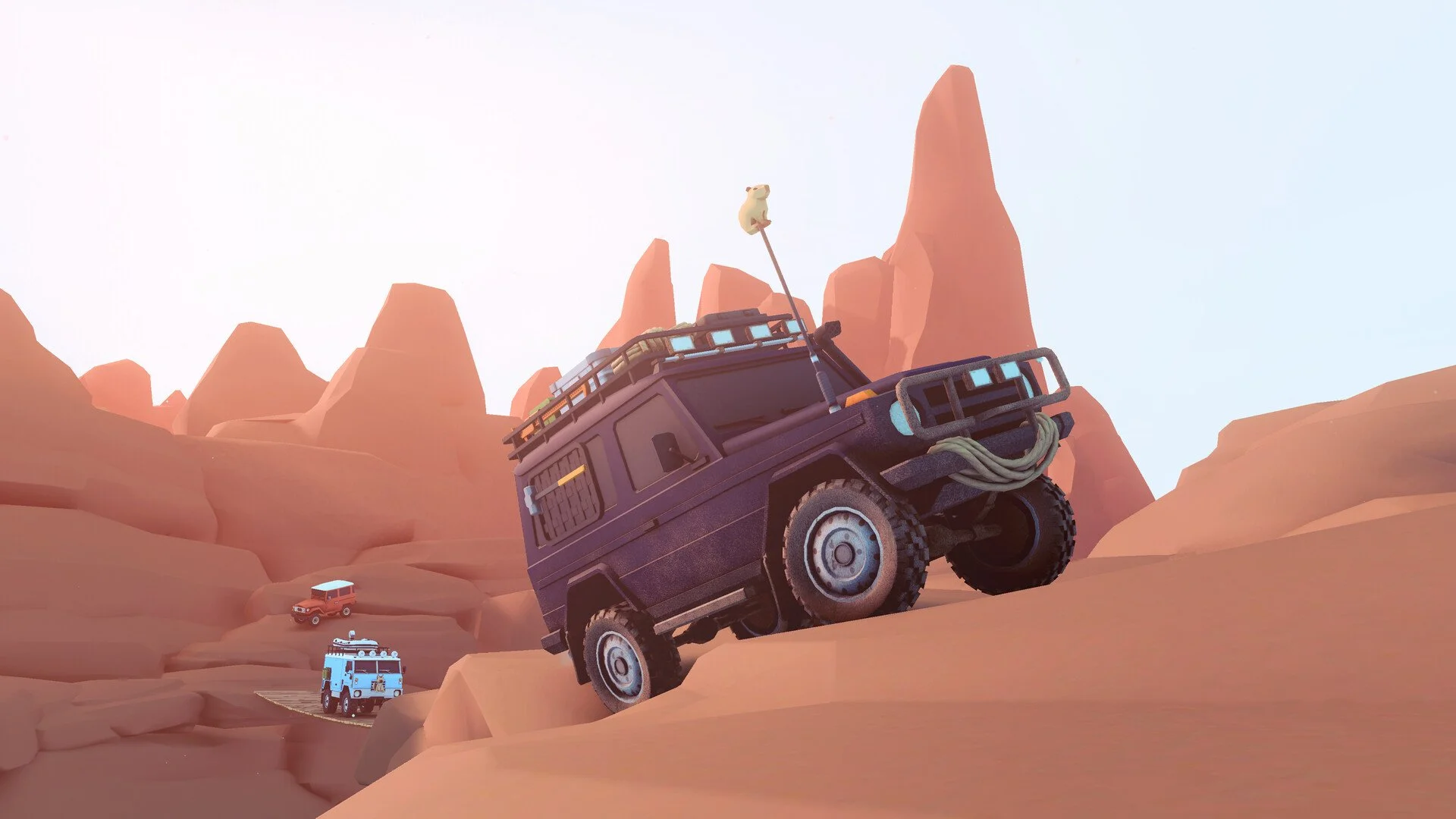
Over the Hill has 21 drivable vehicles, but picking the best one is more complicated than finding whichever has the biggest engine. Torque, gearing, tire grip, wheel size, suspension travel, steering angle, and vehicle weight all change how a 4x4 handles difficult terrain, and several cars that look completely different are much closer mechanically than their bodies suggest.
Jump To Section:
What Is the Best Car?
Why Das Mammoth and The Marshal Are So Strong
Best Car for Technical Trails
Best Midweight Car
Best Heavy Alternative
Why Some Cars Perform Almost the Same
Which Car Stats Matter Most?
What Is the Best Car in Over the Hill?
Das Mammoth and The Marshal are the best overall vehicles in Over the Hill based on their current performance data. Both combine 256 Nm of peak torque with a 5.5 first gear, 0.52-meter wheels, 70 cm of suspension travel, 1.30 forward tire grip, and 1.27 cornering grip.
Those numbers matter together. They have the highest torque tier, the largest wheels among the main off-road classes, the longest suspension travel, and stronger tire grip than the standard medium-tire vehicles. Their shorter first gear also multiplies that engine torque more aggressively when crawling over steep or uneven terrain.
There is not a meaningful mechanical reason in the published drivetrain data to rank Das Mammoth above The Marshal or vice versa. Their major performance figures are effectively identical, so I would treat them as joint best overall and choose whichever vehicle you prefer visually.
Best overall: Das Mammoth or The Marshal. Both combine the game's highest published torque tier with 70 cm suspension travel, 0.52-meter wheels, strong tire grip, and crawler-friendly gearing.
Why Das Mammoth and The Marshal Are So Strong
The advantage is not simply their 256 Nm torque figure. Both vehicles also use a 5.5 first gear compared with 4.7 on the midweight and workhorse classes and 4.2 on most lightweight trail vehicles.
A lower crawling gear lets more of the engine's torque work against difficult terrain at low speed. Combine that with their large tires and they are better equipped to climb over rocks, ledges, deep ruts, and other obstacles without relying entirely on momentum.
The 70 cm suspension travel is another major advantage. Over the Hill regularly puts individual wheels at very different heights, and additional travel gives the suspension more room to follow irregular ground rather than forcing the entire vehicle to move with every obstacle.
The tradeoff is mass and maneuverability. Both weigh 3,200 kg and have a maximum steering angle of 28 degrees, compared with 38 degrees on the lightweight trail vehicles. They are therefore excellent when the terrain itself is the problem, but they are not automatically the easiest vehicles to maneuver through every tight route.
Best Car for Tight Technical Trails
For routes where positioning matters more than brute force, Das Wombat is one of the most interesting alternatives.
It weighs only 1,600 kg and has a 38-degree maximum steering angle, giving it considerably more steering authority than the heavy expedition vehicles. It also has 55 cm of suspension travel and 0.43-meter wheels.
That last figure separates it slightly from several vehicles in the same lightweight family. The Protector, The Brick, The Bull v1, The Tinny, and The Trailrat share the same 112 Nm torque, 1,600 kg mass, 38-degree steering angle, and 55 cm suspension travel, but most use 0.40-meter wheels. Das Wombat keeps the same maneuverable chassis while gaining slightly larger tires.
It cannot match Das Mammoth or The Marshal when raw traction and crawling power are required, but that is not always what a difficult trail needs. On narrow routes where you repeatedly need to change direction, place individual wheels carefully, or avoid dropping one side of the vehicle off an obstacle, the tighter steering becomes much more valuable.
Best Midweight Car in Over the Hill
The Trail Burner and The Cumbre are the strongest choices if you want something between the lightweight crawlers and the massive expedition trucks.
Both weigh 2,000 kg, produce 151 Nm of peak torque, use a 4.7 first gear, have 50 cm of suspension travel, and ride on 0.44-meter wheels. They also have a 33-degree maximum steering angle, splitting the difference between the 38-degree lightweight vehicles and the 28-degree heavy classes.
This middle category makes sense for general exploration because you give up some of the Mammoth's extreme obstacle capability without dropping all the way to the 112 Nm lightweight engine class.
The Trail Burner and Cumbre are another example of why there is no reason to rank every body style separately. Their important performance figures overlap so heavily that the better choice comes down largely to which vehicle you want to drive and customize.
Best Heavy Alternative to Das Mammoth
The Blast Wagon is my pick from the 2,800 kg workhorse class.
It produces 207 Nm of peak torque and uses a 4.7 first gear, putting it below the Mammoth and Marshal but comfortably above the lightweight and midweight classes. More importantly, its 0.48-meter wheels are larger than most other vehicles in the same 2,800 kg group, and its tires have the stronger 1.30 forward and 1.27 cornering grip values.
The Boar has the same 207 Nm output and strong tire grip but slightly smaller 0.46-meter wheels. The Burro also produces 207 Nm, but its 0.40-meter wheels and standard 1.10 forward grip make it less convincing as a pure terrain-first choice.
That makes The Blast Wagon a useful compromise if you want the heavier work-truck feel without moving all the way into the 3,200 kg Mammoth and Marshal class.
Why Some Over the Hill Cars Perform Almost the Same
One of the more important things to understand when choosing a car is that Over the Hill does not give every vehicle a completely independent mechanical setup.
Several cars share the same underlying performance package. The lightweight trail group repeatedly uses a 1,600 kg chassis, 112 Nm engine, 4.2 first gear, and 38-degree steering angle. The wagon group commonly moves to 2,000 kg and 151 Nm with a 4.7 first gear and 33-degree steering, while the workhorse class moves toward 2,800 kg and 207 Nm.
What differentiates individual vehicles inside those groups can be wheel radius, suspension travel, tire grip, and unsprung mass rather than a completely different engine.
This means unlocking a new car does not always mean you have found a direct upgrade. Sometimes you have unlocked another interpretation of a mechanical class you already own.
That is also why I would not recommend spending upgrade currency across several similar vehicles immediately. Pick a chassis you like driving first, then improve its Tires, Suspension, Engine, Winch, and tool capacity as needed.
Which Car Stats Matter Most?
Peak torque is useful, but it should never be read by itself. A vehicle's first gear determines how aggressively that torque is multiplied at low speed, while mass determines how much vehicle the engine has to move.
Tire grip controls how effectively the vehicle can actually use that force before the tires begin slipping. Wheel radius affects how easily the tire can physically roll across larger obstacles, while suspension travel determines how much uneven terrain the chassis can absorb while allowing the wheels to move independently.
Steering angle matters for a completely different reason. Das Mammoth may have far more power than a lightweight trail vehicle, but its 28-degree maximum steering angle gives it less ability to make tight corrections than the 38-degree lightweight class.
That creates a useful way to choose a vehicle rather than looking for a single stat:
For difficult terrain: Das Mammoth or The Marshal.
For tight technical routes: Das Wombat.
For balanced exploration: The Trail Burner or The Cumbre.
For a heavy workhorse: The Blast Wagon.
Upgrades can improve any of these vehicles further, but they do not erase the basic differences between their chassis. A lightweight crawler remains easier to position, while the expedition trucks retain the advantages of their larger wheels, greater suspension travel, stronger grip, and higher torque.
For more on what to upgrade first and how to handle difficult terrain, our Over the Hill Tips and Tricks Guide covers vehicle upgrades, low range, recovery tools, route planning, and challenge trails.